

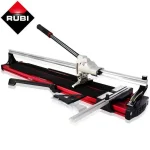

RUBI FONE800 Tile Cutter
Price on request
Where this frame sits in a tiling kit
The model is FONE800, and the first thing worth understanding about it is that it is a manual frame built around a single scoring pass. There is no water tray, no blade motor, and no cable to route across a floor you have just finished. That absence is the whole point: on occupied sites, the tool that needs no supply keeps working after the temporary power is locked off for the night.
What you give up is speed on very hard porcelain and any ability to cut curves. What you gain is portability, a dry floor, and an edge that needs no drying time before the tile goes down. Most fit-out crews end up running one of each, a wet saw for the awkward pieces and a manual frame for the straight run that makes up most of the metreage.
Reading the frame before you commit
Three things decide whether a manual cutter is honest or decorative: how rigid the guide rail stays under load, how squarely the breaker descends relative to that rail, and whether the base has enough bearing surface to hold the tile flat while the scoring wheel travels. Flex in any of the three shows up in the same way, as a cut that runs true for the first third and then drifts.
Ask what breaking force the frame is rated to rather than how long the bed is. A long bed over a soft breaker is a very expensive ruler, and it will disappoint on thick porcelain no matter how carefully it is set up.
The scoring pass is the entire job
Score once, with steady pressure, from the near edge to the far edge in a single travel. Two light passes do not add up to one firm pass. They cut two shallow grooves, and the breaker then follows whichever of them it prefers, which is how a tile ends up snapped off line at the far end while looking perfect at the near end.
Keep the wheel clean. One grain of dried adhesive under the scoring wheel lifts it clear of the glaze for a few centimetres, and that gap is precisely where the break will wander when you press the breaker down. Wiping the wheel and the rail between pieces costs seconds and saves tiles.
Setting the guide for a run of repeat cuts
For a set of identical pieces, set the stop once and then check the first three against a square rather than against each other. Three pieces that agree with a square are a setup you can trust. Three pieces that agree only with one another are a consistent error, and you will not discover it until the run is bedded and the joints open up at one end.
Mark from the glazed face and score on the glazed face. Scoring the back is a habit carried over from soft ceramic, and on porcelain it produces a ragged edge because the biscuit is far coarser than the glaze layer the wheel is designed to track through.
Materials that behave and materials that argue
Glazed ceramic, most porcelain, and full-body vitrified tiles cut cleanly once the breaker is set sensibly. Mosaic sheets and thin-format panels do not. They deflect under the wheel, the score never reaches full depth, and the break follows the mesh rather than your line. Those belong on a wet saw, and pretending otherwise is how a morning disappears.
Spares that keep the frame earning
Scoring wheels are consumable and cheap, so keep two on the van. The breaker pad wears faster than people expect, and a glazed-over pad concentrates force at a single point, which is exactly how corners chip on the last centimetre of a cut. The rail should be wiped and stored dry, because a rail put away with grit on it will slowly score its own carriage.
What to inspect when the crate arrives
Check the rail for straightness against a machine square rather than by eye. Check that the breaker descends squarely across its full width. Check the base feet for flatness on a bench you already know to be flat, and run the carriage the full length of the rail looking for a tight spot, which usually means a bent rail rather than a tight bearing.
Then cut one tile you do not need. A frame that arrives square can still be assembled wrong, and one sacrificed tile on the first morning is considerably cheaper than a run of short pieces discovered after the adhesive has gone off.
| Model | FONE800 |
|---|---|
| Type | Tile Cutters |


Reviews
There are no reviews yet.