
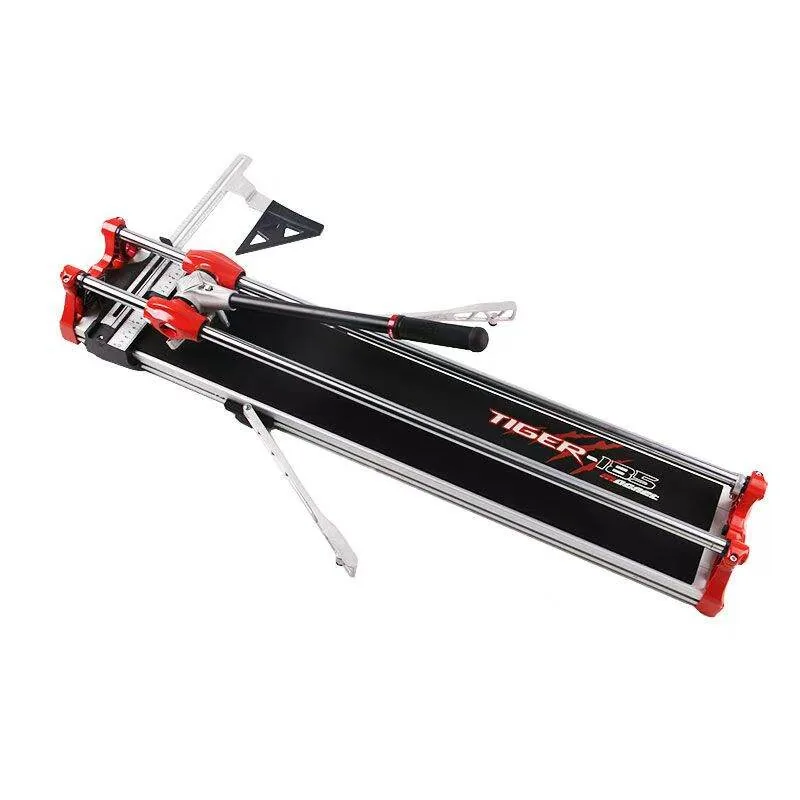
RUBI TIGER-1600PLUS Tile Cutter
$209.99
Accuracy is a routine, not a specification
The model is TIGER-1600PLUS, a hand tile cutter at the longer end of this range, and the thing that separates a tool like this from a cheaper one is not the cut it makes on the first day. It is whether it still makes that cut after a hundred pieces, which depends on how the frame resists the loads the operator puts through it.
Accuracy in cutting is therefore maintained rather than delivered. A cutter is a frame, a rail and a breaker, and all three move over time; the question is whether the movement is small enough to be corrected by routine checks or large enough to scrap the tool.
A baseline you can return to
When the tool is new, cut three pieces and keep one as a reference. Mark it with the date. From then on, any suspicion about accuracy is settled by cutting a piece and comparing it with the reference rather than by argument.
This costs one tile and answers a question that otherwise gets discussed for a week. It also tells you when a change in behaviour belongs to the tool and when it belongs to the material, which are two very different repairs.
Checking square without a metrology lab
Cut a piece, then cut it again from the opposite edge and compare the two cut edges for parallelism. If they converge, the fence or the stop is out of square with the rail. It is a two-minute test that requires nothing but the tool and one scrap tile. Repeat it after any move between sites. Transport is when squareness is lost, and the loss is small enough at first to be attributed to technique.
The long frame and the long piece
A long frame invites long pieces, and long pieces need support along their whole length rather than at the ends. Overhang at either end turns the piece into a spring, and a spring releases its energy into the break, which is why long cuts run out.
Set trestles level with the bed before the first cut, and check them again at lunchtime. Trestles settle, and a settled trestle is a tilt that shows up as a taper over the length of the piece.
What the extra length costs you
A longer frame is heavier and less convenient to move, and in a small room it can be more of a problem than a help. The honest test is whether the work regularly contains pieces longer than a shorter frame could carry; if it does not, the length is being paid for in handling.
Where both sizes are available on a job, keep the long frame set up in one place and use a shorter one for the small cuts. Moving a long frame repeatedly is how frames go out of square.
Consumables and adjustment
The scoring wheel and the breaker pad are the wear items, and both change the character of the cut before they fail outright. A wheel that no longer scores consistently should be replaced rather than pressed, and a pad with a groove worn into one spot should be replaced before it chips a corner.
Check the carriage for play at the same interval. Play in the carriage produces a score of varying depth, and no amount of pressure control compensates for it.
Acceptance on delivery
Check the frame diagonals, the rail straightness, and the breaker alignment at both ends of the bed rather than only at the centre. Confirm the stop locks positively and that the carriage runs the full length without a tight spot. Then cut the reference piece described above and keep it. On a tool of this size, that piece is worth more than the inspection sheet that came with it.
| Model | TIGER-1600PLUS |
|---|---|
| Type | Tile Cutters |
Reviews
There are no reviews yet.