
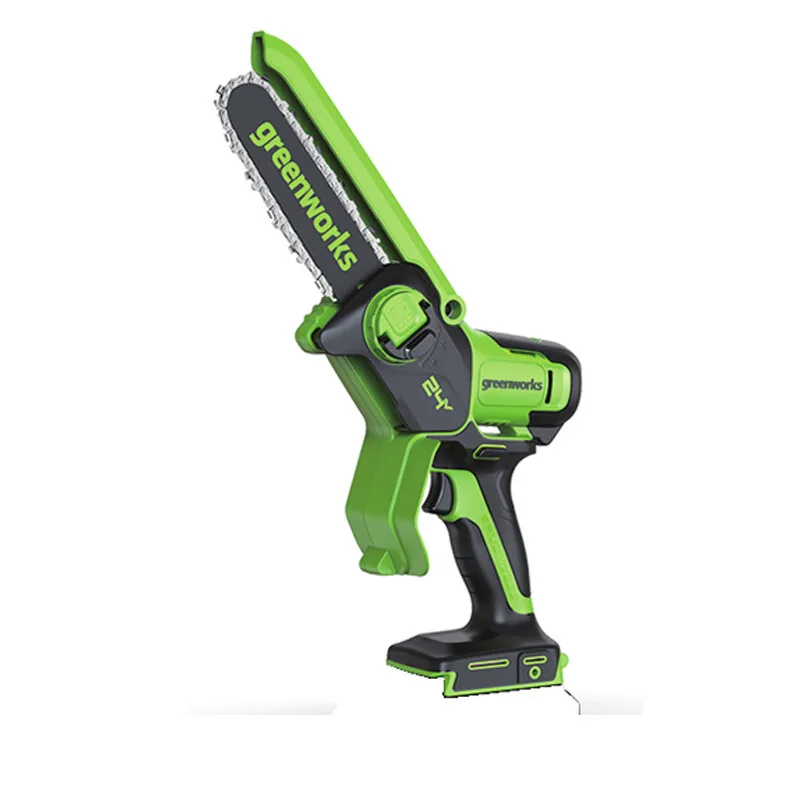

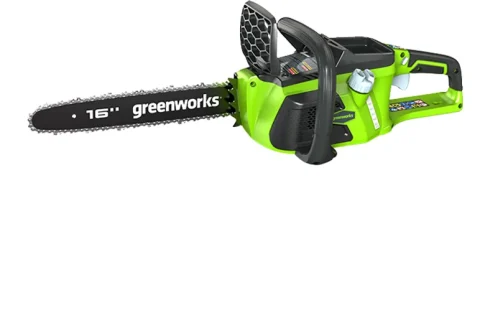
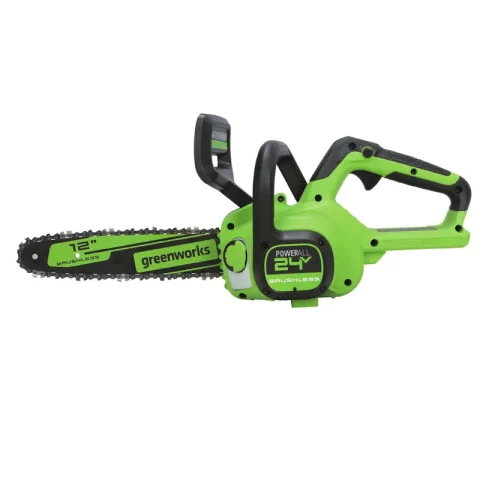
GREENWORKS Chainsaw Mini Brushless 24V
$79.99
A small saw is a limb saw, not a felling saw
A cordless mini chainsaw is built for branches: limbing a fallen tree, pruning, cutting up storm damage that is already on the ground. It is not a felling saw, and the limitation is not the bar length but the energy in a single pack and the absence of a spiked bumper to control the cut.
Buyers who expect a small saw to do a big saw’s work usually discover the difference at the moment the chain binds in a log too large for the bar. Bars sized to the wood, not the wood forced to the bar, is the rule that keeps both the saw and the operator intact.
Chain speed, torque and the cut that stalls
A cordless saw’s chain speed is usually lower than a petrol saw of similar size, and its torque curve is flatter at low speed. In practice that means it cuts small diameter wood quickly and stalls in large diameter wood, where the chain needs torque rather than speed to keep clearing chips.
Stalling is a signal, not a fault. Forcing a stalled saw heats the motor and the pack and shortens both, and it usually ends with a pinched bar that has to be freed by hand.
What the registry carries for this entry
The model as listed, the size marked 24V and the price on this page. Bar length, chain pitch and gauge, drive link count, oil tank capacity, chain speed, weight and pack capacity are not in our data.
On a chainsaw the chain specification is not a detail; it is the part that has to match when a replacement is needed. Without pitch, gauge and link count, a replacement chain cannot be ordered with confidence, which is the practical reason to obtain them at purchase.
Bar length and the wood it actually suits
The usable cutting capacity is the bar length minus a margin at each end, and the honest rule is to cut wood no larger than about two-thirds of the bar. A bar pushed to its limit buries the nose sprocket in the cut, which is where kickback originates and where the saw has least control.
For a small saw the working range is branches and small logs. Where the wood is larger, the correct sequence is to cut from both sides or to use a larger saw, not to force the bar through.
Oil, tension and the two-minute checks
A chain needs bar oil continuously. A cordless saw with a small tank runs dry faster than operators expect, and a chain run without oil glazes the bar and destroys the chain in minutes. Check the oil level at every battery change, not at every session.
Tension is checked cold, with the chain able to be lifted just clear of the bar at mid-length. A chain tensioned hot will be too tight when it cools; one left loose will derail and damage the drive links.
Kickback and the grip that prevents it
Kickback happens when the upper part of the bar nose contacts wood, and the saw is thrown up and back toward the operator. Every safeguard in a chainsaw, the chain brake, the low-kickback chain, the hand guard, exists to interrupt that motion. A saw held with one hand cannot be controlled during kickback.
Hold with both hands, stand to the side of the cut line, keep the thumb wrapped under the handle, and never cut above shoulder height. Those four habits remove most of the ways a small saw injures people, and none of them depends on the machine.
What to confirm before buying
Bar length, chain pitch, gauge and drive link count, oil tank capacity, chain speed, weight with pack, pack capacity, and whether a spare chain and a bar cover are included. Ask which replacement chain part number fits, and write it down.
Tell us the largest diameter you will cut. That answer decides whether this class is adequate, and it decides it before the price is considered.
| Type | Chainsaws |
|---|---|
| Voltage | 24 V |
Reviews
There are no reviews yet.