
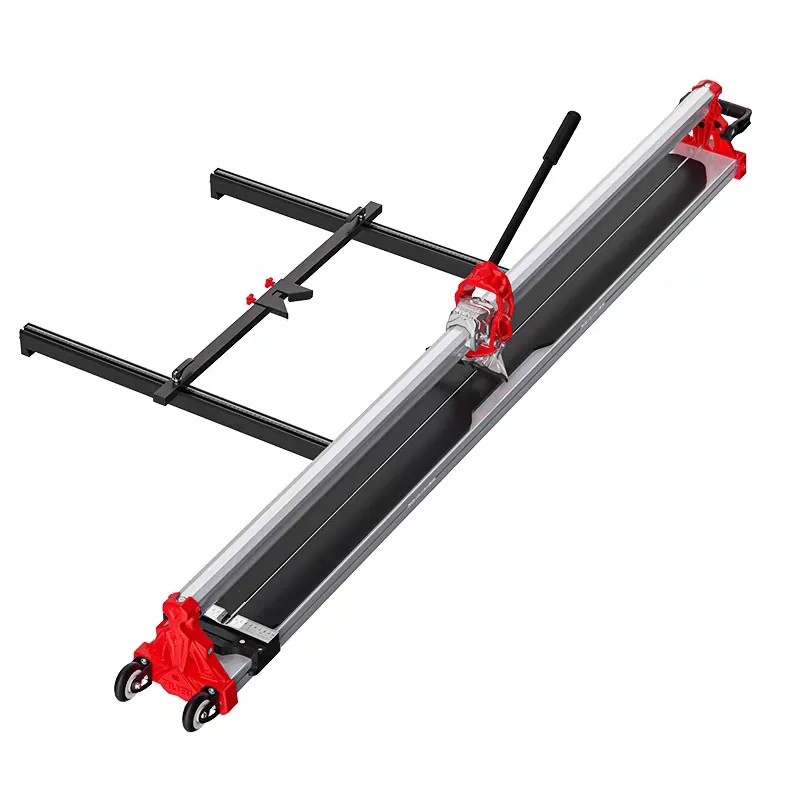
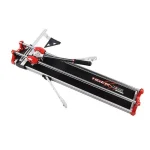
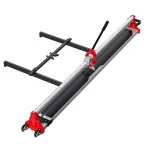
RUBI 1600 Tile Cutter
$226.99
Comparing two cutters that look the same
The model is 1600, a hand tile cutter, and the problem it poses to a buyer is the one that costs the most money in this trade: two tools of the same nominal size, at different cost, with no visible difference on a catalogue page. The difference is always in the parts that do not photograph — the rail section, the breaker linkage, and the quality of the stop.
So compare those specifically rather than comparing the headline size. A cutter with a heavier rail and a properly guided breaker will hold accuracy through a floor of work; a lighter one will hold it through a morning.
Rail section and what it does under load
The rail is a beam, and a beam deflects. A deeper section deflects less for the same push, which matters because the operator’s push is what varies between people and between pieces. The visible consequence of a rail that is too light is a score that is deeper in the middle of the travel than at the ends.
You can feel this without instruments: score a long piece slowly and watch the wheel. A rail that flexes shows the wheel dipping as it passes the centre of the span.
The breaker linkage
The breaker converts a small hand movement into a large force at a small area, and the linkage is where cheap tools economise. A linkage with excessive play delivers the force unevenly, which chips the edge at the point where the pressure peaked instead of cracking evenly along the score.
Test it on scrap with a piece of the material you actually lay. A clean break with a straight edge and no chipping at either end indicates a linkage that is doing its job.
The stop, and why it matters more than it looks
Repeat work lives or dies on the stop. A stop that creeps under pressure produces a run of pieces that are all slightly different, and the error only becomes visible when they are laid and the joints are not consistent. Check that the stop locks with a positive action and that it does not shift when the breaker is operated. If it shifts, every cut in a run is a slightly different cut.
What should be in the crate
Confirm that the scoring wheel, the breaker pad, the spanner and the stop are all present, and that the spare wheel if supplied is the correct type. Missing small parts are the most common shortfall on deliveries of this kind, and they are the most annoying to resolve afterwards. Keep the packing list with the tool. On a site, the list is the only record of what was supposed to be in the box.
Spares and service life
A cutter of this class should last years if the frame stays square and the wear parts are replaced. The parts that fail are the wheel, the pad and occasionally the carriage bearings; all are inexpensive and all should be available as parts rather than as assemblies.
Ask for the part numbers when the tool is bought. A tool whose wear parts cannot be identified is a tool that will be discarded for want of a small component.
Acceptance checks
Check the diagonals of the frame, the straightness of the rail and the alignment of the breaker at both ends of the bed. Work the stop and confirm it locks. Then cut scrap and inspect the break along its whole length rather than only at the visible face.
Look at the underside of the break. A clean break shows a consistent fracture line; a wandering one shows a stepped surface, and that is the earliest sign that the setup is out.
| Model | 1600 |
|---|---|
| Type | Tile Cutters |
Related products
Reviews
There are no reviews yet.