
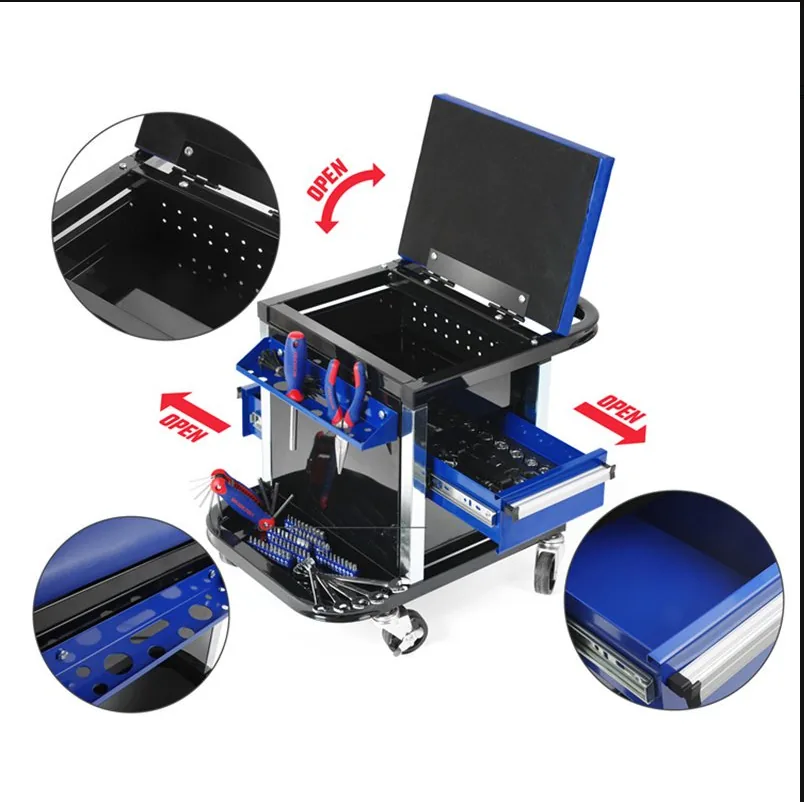

WORKPRO Creeper Seat
$67.99
What a creeper seat does that a mat does not
A mat protects the floor. A creeper seat changes the geometry of the person working on it. Sitting at wheel-arch height puts the eyes closer to the work and takes the load off the knees, and on a job that runs an hour or more that difference decides whether the work gets done properly or gets rushed to get the technician off the ground.
That is the whole case for the class. It is not a comfort accessory; it is a way of holding a working posture that a kneeling mat cannot hold, because a mat still leaves the body weight on the knees and the shins.
Frame, castors and the seat pan
Three parts decide whether a seat survives a workshop. The frame carries the load and takes the abuse of being dragged rather than rolled. The castors decide whether it moves when pushed and stays put when leaned on. The seat pan decides whether an eight-hour shift ends with a bruise.
On the frame, look for continuous tube rather than pressed sheet. Sheet frames fold at the corners under a heavy technician, and once a corner folds the castors no longer sit square and the seat starts steering itself. On the castors, look for a diameter large enough to cross a weld bead or an air line without stopping dead.
Registry facts for this entry
What we hold for this item is the model, the SKU and the price shown on this page. Load rating, seat height, castor diameter, frame material and product weight are not recorded in our data, and we do not fill them in from a similar-looking seat.
For a product that will be sat on, that gap matters more than usual. The load rating is the one number a buyer should insist on before a hundred units go into a service bay, and we would rather send you to the supplier for it than invent it here.
Where it earns the floor space
Wheel and brake work, lower engine bay access, panel work along a sill, and detailing at bumper height all suit a rolling seat. So does any task where the technician needs to move sideways repeatedly without standing up, which is why body shops buy them in multiples rather than singly.
Where it does not earn its space: pit work, where the floor is already at the right height, and any environment with a sloping or grated floor, where small castors will follow the slope or drop into the gaps.
Checks before dispatch
Each unit is assembled and sat on briefly rather than only inspected. A castor that binds under load will feel free when the seat is empty and locked when it is not, so an unloaded check proves nothing. The seat pan is pressed at the edges, where a thin moulding gives way first.
We also roll the seat across a length of floor and watch whether it tracks straight. A frame welded out of square shows up as a curve over three metres, which no static inspection will reveal.
Carton, assembly and freight
Seats ship partly disassembled: frame, pan and castors in one carton with fasteners bagged. The carton is bulky but light, so freight is rated on volume rather than mass, and a seat sent alone is expensive per unit compared with a pallet of ten.
Assembly at destination takes minutes with a single spanner, but the fasteners are the part that goes missing. We check the bag count against the parts list on every carton, because a missing castor bolt turns a delivered order into a return.
What to confirm before ordering
Ask for the load rating, the seat height range, the castor diameter and type, and whether the castors are braked. Height decides whether the seat suits your benches; castor diameter decides whether it survives your floor; the load rating decides whether it survives your heaviest technician.
If you are buying for a team rather than one bay, say so. Quantities of ten and above change both the freight and the packing, and it is cheaper to plan that at quotation than to discover it at the loading dock.
| Model | WP319004 |
|---|---|
| Size | 36 x 45 x 52 cm |
| Type | Creeper seat with drawers |
| Wheel Diameter | 64 mm |
Reviews
There are no reviews yet.