
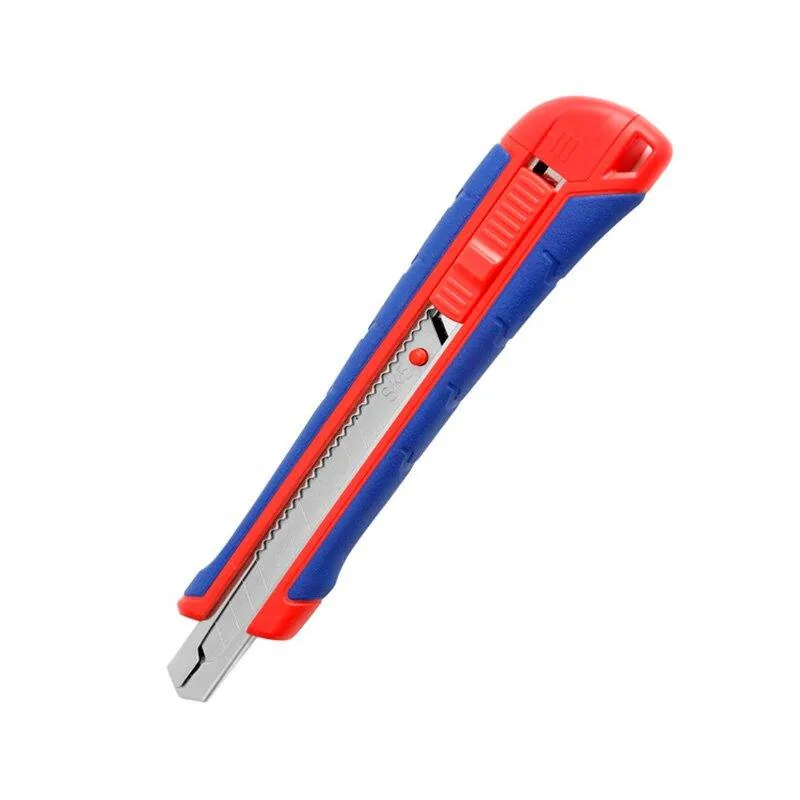
WORKPRO Utility Knife 9mm – WP212008
$1.99
Overview
A snap-off knife in the narrow format takes a segmented blade that is scored across its width, so a dull tip is renewed by breaking the used segment away on the notch of the holder. The WORKPRO 9 mm entry in this catalogue sits in that narrow group rather than among the heavy trade knives: the blade is slim, the body carries it close to the work, and the whole tool drops into a shirt pocket or an apron loop.
Catalogue entry as listed: WORKPRO Utility Knife 9mm (reference WP212008). The registered size is 9 mm and that is the only dimensional figure recorded against this item, so the notes below describe the class of narrow snap-off knives and leave everything item-specific to the confirmation list at the end.
Materials and construction
Narrow knives of this type are commonly built around a zinc-alloy or glass-filled plastic body, with a thin steel spine that the blade slides along. The blade itself is usually a carbon tool steel strip, hardened and then ground to a single bevel; the visible grind line is what keeps the cut tracking straight when the blade is only partly extended. Bodies in this class are frequently assembled from two halves held by one screw, which lets the channel be cleaned of adhesive residue without reaching for tools.
How to select the right size and variant
Choose the narrow format when the material is thin and the cut has to follow a printed line: paper, film, vinyl, light carton and gasket sheet all release better under a short blade with little side flex. What matters at the point of order is the blade standard the holder accepts, whether the body is die-cast or moulded, and whether the knife is meant to be carried or kept on a bench. A pocket clip and a lanyard hole read as decoration on a specification sheet but decide whether the tool survives a shift inside a maintenance pouch.
Typical applications
Fitting shops use this size for trimming laminates, applying vinyl graphics and opening cartons without scoring the goods inside. Print rooms keep one beside the guillotine for trimming proofs and cutting down mount board. Electrical and HVAC crews reach for the narrow blade when stripping cable sheath or cutting insulation tape, where a wider blade would wander off the line.
Standards and acceptance checks
Three checks decide whether a delivery is usable in the hands of a customer. First, blade retention: with the blade extended and locked, the tip should not rock side to side under light hand pressure. Second, tracking: a cut guided along a steel rule should stay parallel over the full length of the sheet. Third, snap quality: a scored segment should break on the notch and leave a square end rather than a jagged shoulder that catches in the material.
Packing, quantity and shipping
Retail-ready knives of this size are commonly carded or blister-packed for shelf display, while bulk orders ship in plain inner boxes with the blades fitted or packed separately. Ask for the inner-box count before quoting retail packaging, because the card size drives carton dimensions and carton weight more than the knife itself does. Where blades travel loose, they should sit in a rigid sleeve so that edges do not chip in transit.
What to confirm before ordering
Confirm the blade standard and steel grade you expect, whether spare blades are included in the pack, and which lock style the buyer accepts. Confirm the printing or label requirement for the card, the inner-box count and the carton marking. Confirm whether the handle colour has to match an existing tool set, and whether the knife is sold as a single unit or as part of an assortment.
| Model | WP212008 |
|---|---|
| Type | Utility Knives |
| Width | 9 mm |
Related products
Reviews
There are no reviews yet.