

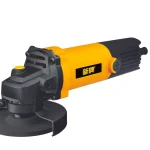

HUALI AG15-100 Angle Grinder Brushless
Price on request
Brushless, and what that actually changes for the owner
The model is AG15-100, a brushless angle grinder. The motor has no carbon brushes to wear, which sounds like a marketing line until you count what brushes cost over a working life: not the parts themselves, but the downtime, the trips to a dealer, and the slow loss of power that operators compensate for by pushing harder than they should.
What brushless does not do is make a tool indestructible. Heat still kills motors, and the electronics that drive a brushless motor are themselves sensitive to heat and to the dust they sit in. The advantage is that the wear parts moved out of the motor and into the environment, which means the tool’s life now depends more on how it is treated between jobs than on a service interval.
The single-hand class of grinder
A grinder in this size class is normally used one-handed for light work and two-handed whenever the disc is buried. Most operators in this class work on ladders, inside cabinets, or over their heads, which is exactly where a lighter tool matters and exactly where the temptation to skip the guard is strongest.
If most of your work is heavy stock removal on a bench, this is not the right purchase. A tool in this class trades sustained cutting force for control and reach, and pushing it beyond that trade is how motors burn out on a site where nobody can explain why.
Discs decide the finish, not the tool
Two grinders of the same specification will produce visibly different results on the same job if one is wearing the right disc. A thin cutting disc flexes if it is levered sideways, which is how they shatter; a grinding disc loaded with the wrong material clogs and heats the work; a flap disc leaves a finish that looks acceptable and hides a surface that will not take paint evenly.
Match the disc to the operation, keep cutting discs for cutting only, and never mount a disc rated below the speed the tool runs at. The rating on the disc is a limit, not a suggestion, and it is the one specification where guessing has consequences.
Guarding, grip and where your hands should not be
The guard exists to catch the debris that comes off a disc in the first moments of a failure, and to stop a shattered disc from travelling along the line of the cut. Rotating it so the closed side faces the operator is a decision made per job, not a setup step to be done once and forgotten.
Grip matters more than most people admit. A tool held loosely is controlled by the reaction of the disc rather than by the operator, and the moment the disc grabs, the tool goes where the work pushes it. Both hands on a grinder that has two handle positions is not caution, it is basic control.
Dust, heat and the duty cycle nobody reads
Grinding produces two things that shorten motor life: fine conductive dust, and heat. In this class of tool, most failures that are not mechanical come from one of the two. A grinder working continuously in a cloud of metal dust will pull that dust through its cooling path, and the same grinder will overheat if it is run flat out for long stretches at a time without a pause.
Commonly the honest duty for a hand-held grinder is intermittent, not continuous. If the job needs a tool running without a break for long periods, that is a job for a different class of machine, and using a hand tool for it will be paid for in motor replacements.
Spindle lock and changing a disc safely
Use the spindle lock to hold the spindle while the flange nut is loosened, and never use it to stop a spinning disc. The lock pin is small and designed for static load; stopping a disc with it is how it shears. Let the tool come to a complete stop before you touch anything. Check the flanges for flatness each time the disc is changed. A flange that has been dropped will clamp the disc unevenly, and an unevenly clamped disc runs out of true, which shows up as vibration and, eventually, as a crack starting at the arbor hole.
Checks before the first disc goes on
Turn the spindle by hand and listen for roughness. Check that the guard locks at each detent rather than swinging freely. Check the switch for a positive action in both directions and confirm it returns when released, since a switch that sticks on is the single most dangerous fault a grinder can have. Then run the tool with no disc for a few seconds. A brushless motor that stutters, or one that runs and then cuts out immediately, is telling you something about its electronics before you have committed a disc to it.
| Model | AG15-100 |
|---|---|
| Type | Angle Grinders |
Related products
Reviews
There are no reviews yet.