
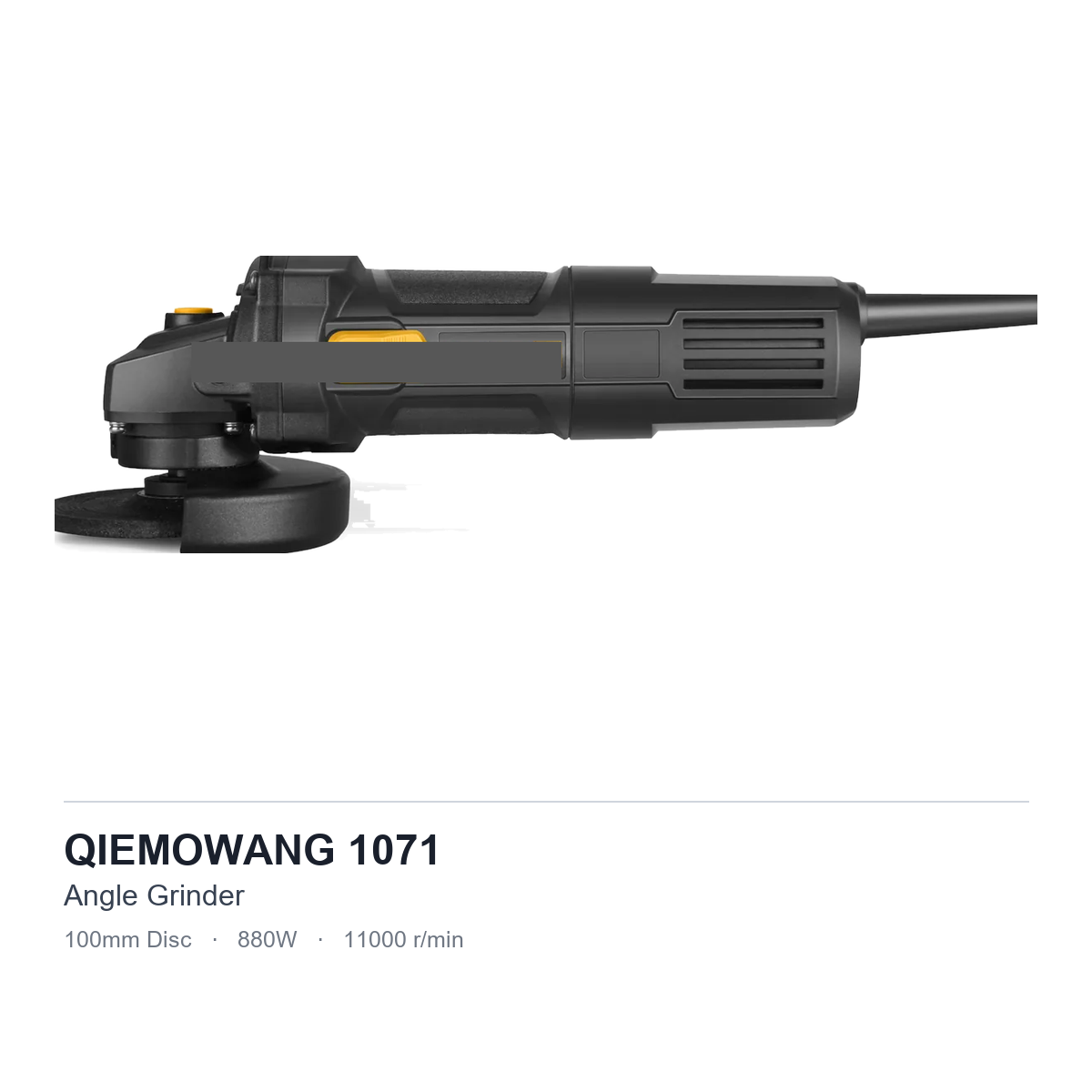

QIEMOWANG 1071 Angle Grinder
$16.99
What a low-ticket grinder really costs over a year
The model is 1071, an angle grinder in the entry part of the range, and the honest way to judge it is over twelve months rather than at the counter. The purchase figure is the smallest number in the calculation. Discs, cable repairs, and the hours lost when a tool stops halfway through a cut are all larger, and they are the numbers a buyer never sees on a quotation.
That does not make a cheap grinder a mistake. It makes it a tool with a defined envelope, and the whole question is whether your work sits inside that envelope or pushes against its edges every week.
Where the money went, and where it did not
In any grinder at this level, the cost has been taken out of the parts you cannot see: the grade of the bearings, the balance of the armature, the thickness of the field windings, and the quality of the switch. None of these affect how the tool feels in the first five minutes, which is precisely why they are the first things reduced.
What that means in practice is a tool that performs correctly when new and reveals its compromises after a few months of daily work, usually as vibration, a hotter body, or a switch that needs a second press. Those symptoms are the envelope becoming visible.
Disc fitment and the arbor question
Check the arbor thread and the flange diameter before buying a stock of discs. A grinder whose flange is slightly undersized will clamp a disc off-centre, and an off-centre disc wears unevenly, vibrates, and eventually cracks from the arbor outward. This is one of the few faults where the tool damages the consumable rather than the other way round.
Keep the pin spanner with the tool rather than in a drawer. Flange nuts tighten themselves with use, and a grinder whose spanner has been lost gets its disc changed with a chisel, which is how spindles and flanges get ruined.
The duty this class is honestly built for
In this class, the realistic duty is intermittent: a few minutes of cutting, then a pause, repeated through a shift with the tool resting between jobs. Continuous cutting for long stretches at a time is not what the cooling path or the bearings were sized for, and a tool used that way will fail earlier than its price suggests it should.
Buyers rarely state their duty when they compare tools, and suppliers rarely ask. Being honest with yourself about how the tool will actually be used is worth more than any specification comparison, because it decides whether this class is suitable at all.
Switch, cable and the parts that fail first
When a grinder at this level fails, it is usually the cable at the strain relief, the switch, or the bearings, in that order. Cable failures are almost always handling rather than manufacturing, and they are prevented by not lifting the tool by its lead.
Switch failures are worth watching for a specific reason: a switch that does not return cleanly leaves a tool that can start when it is picked up. Any grinder whose switch feels vague should be taken out of service rather than watched, because there is no benign version of that fault.
Keeping one alive past its warranty
Blow the dust out of the vents rather than tapping the tool against a bench, keep the cable coiled loosely rather than wrapped tight around the body, and store it where it will not sit in damp. These three habits are the difference between a tool that lasts two years and one that lasts five, and none of them cost anything. Replace the cable at the first sign of cracking rather than at the first sign of failure. A cable that has failed intermittently is far more expensive in diagnosis time than a cable replaced early.
What to check on the day it arrives
Run the tool unloaded and listen for a rhythmic noise that would suggest a bearing or an imbalance. Check that the spindle turns freely with the power off, that the guard locks at each detent, and that the side handle threads fully home without wobble. Then fit a disc and make one light cut on scrap, watching for vibration that was not present unloaded. A grinder that is smooth free and rough under load is usually a flange or disc problem, and it is far cheaper to find that on scrap than on a customer’s workpiece.
| Model | 1071 |
|---|---|
| Type | Angle Grinders |
Related products
Reviews
There are no reviews yet.