
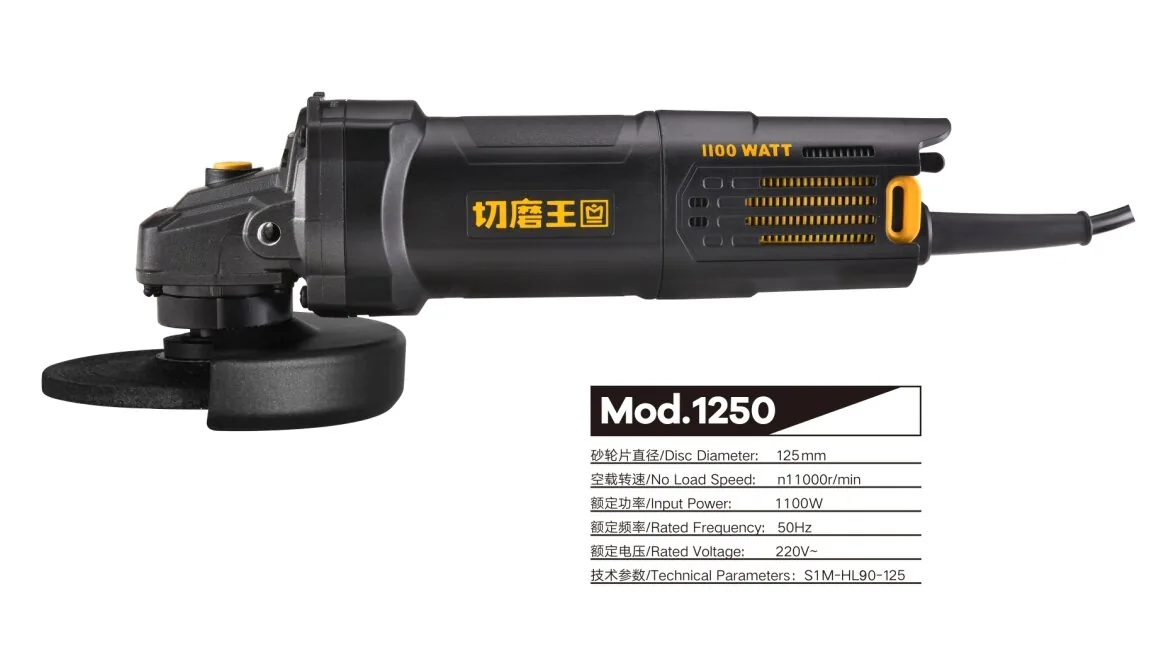
QIEMOWANG 1250 Angle Grinder
$22.99
The step up, and what it actually buys
The model is 1250, one tier above the entry grinders in this range. The question a buyer should ask is not whether it is better, because it is, but whether the improvement lands on the work they do. A step up in this class usually buys bearing quality, winding mass and a better switch, and those show up as smoothness under load rather than as a different number on a badge.
If your work is occasional cutting of light sections, the improvement will be invisible. If your work involves long passes in thick material, it will be the difference between a tool that finishes the job and one that needs a rest before you do.
Bearing quality is the invisible difference
Bearings decide whether a grinder feels tight after a year. Cheap bearings develop play, play shows up as vibration at the disc, and vibration is what turns a cutting disc into a shattered one. This is a chain that starts with a part costing very little and ends with an injury, and it is entirely hidden at the point of sale.
You can feel bearing condition before it fails: with the power off, spin the spindle by hand and listen. A healthy bearing is silent and slightly resistant. A dry or worn one has a faint roughness that gets worse under load, which is why the hand-spin test belongs in the weekly routine rather than in the post-mortem.
Continuous work changes the calculation
Once a grinder is asked to run for long uninterrupted stretches, the limiting factor stops being power and becomes heat rejection. The motor can produce the torque; it cannot shed the heat at the same rate, and the windings take the difference. A tool with more mass in the stator and a better cooling path handles that condition for longer before the temperature climbs into the range where insulation degrades.
This is the honest case for the step up, and it is also the reason a more expensive tool can be the cheaper choice for a workshop and the wasteful choice for a homeowner.
Ventilation and how the tool is held
The air outlets on any grinder are easy to block with a forearm, and blocking them is the most common way an operator shortens a tool’s life without noticing. Working overhead is the worst case, because the natural grip covers the vents exactly when the motor is working hardest. Change grip periodically rather than holding one position for an entire cut. It sounds like comfort advice; it is actually thermal management, and it costs nothing.
When the step up is wasted money
If the grinder spends most of its life in a van and comes out for a handful of cuts a month, the extra bearing quality will never be exercised. Tools deteriorate from storage as much as from use, and a more expensive tool left in a damp van is simply a larger loss when it is stolen or corroded. Buy the tier that matches your duty, and spend the difference on discs and on a case. Both will affect the finished work more than the tool’s position in the range.
Service access and spares
Before committing to a brand for a workshop, check that brushes, switches and cables are available as parts. A tool that must be replaced rather than repaired because no switch can be sourced is a tool with a much shorter working life than its build quality suggests.
Ask what the armature and bearing part numbers are. A supplier who can give them quickly is a supplier who expects the tool to be repaired, and that expectation usually reflects how the tool was designed.
Acceptance checks worth doing
Confirm the guard moves and locks through its full range, that the side handle seats without play, and that the switch returns crisply. Spin the spindle by hand and listen. Then run the tool unloaded for a minute and feel the body temperature, which should rise gently rather than sharply.
Fit a disc and cut a piece of scrap that matches your usual material. A tool that cuts smoothly in its own class of work is doing everything it promised; the rest is consumable choice and technique.
| Model | 1250 |
|---|---|
| Type | Angle Grinders |
Related products
Reviews
There are no reviews yet.