

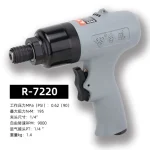

RONGPENG R-7222L Air Screwdriver
Price on request
Overview
An air screwdriver is bought for one property that an electric driver cannot match: it does not care how long the shift is. There is no cell to flatten, no motor to cook, and the torque it delivers on the thousandth screw is the torque it delivered on the first, provided the air supply holds. On a bench where the same fastener goes in all day, that consistency is the whole value of the tool.
Catalogue entry as listed: RONGPENG R-7222L Air Screwdriver (reference R-7222L). Torque range and bit standard are not carried in the buying record, so the notes below describe the class and leave both figures to the confirmation list.
Materials and construction
The body is a die-cast or composite housing around a vane motor, with the clutch at the front and the air inlet at the base of the handle. Vanes run in slots on the rotor and are pushed out by centrifugal force; they wear slowly against the cylinder wall and are the reason a tired tool loses torque before it stops working. The gear train at the nose is usually a planetary set that reduces motor speed to bit speed.
The clutch is what separates one air screwdriver from another. An adjustable slip clutch slips at a set torque and keeps turning, which suits soft joints and self-tapping screws where the driver should not stop dead. A shut-off clutch cuts the air when the torque is reached, which suits hard joints and repetitive assembly where over-tightening would damage the part. A direct-drive tool has no clutch at all and stalls against the joint, depending entirely on the operator’s wrist.
How to select the right size and variant
Torque range comes first: the tool should sit in the middle of its range at the buyer’s working torque rather than at the top, because a clutch held at its limit drifts. Bit standard comes second, since the holder determines which bits the buyer can use and how quickly they can be changed. A quarter-inch hex quick-change holder is the common choice for assembly work; a bit-holder with a finder sleeve suits screws that must be started straight.
Speed and air consumption follow. A fast free speed suits small screws in soft material, while a slower tool with more torque suits larger fasteners. Consumption has to be matched to the compressor and the number of tools on the line, because a bench of six drivers drawing from one small receiver will all lose torque at once when a seventh operator starts.
Typical applications
Furniture plants run air drivers on cam locks, hinges and knock-down fittings all day. Appliance assembly uses shut-off clutches so that panel screws are uniform. Electronics benches use low-torque tools with a soft clutch on plastic housings. Vehicle workshops use them on trim, undertrays and interior panels where a hand driver would be too slow. Packaging lines use them on crate and pallet assemblies.
Standards and acceptance checks
Three checks settle a delivery. Torque repeatability: run twenty fasteners into a test joint and check the spread, since a clutch that drifts is worse than one set low. Free speed and sound: run the tool unloaded and listen for a smooth note without a scraping rattle from the gear train. Air circuit: check for leaks at the inlet, the trigger valve and the exhaust, and confirm the tool stops instantly when the trigger is released rather than coasting.
Reaction torque is the safety issue on a driver of this size. The tool should be held so that the wrist is not taking the full reaction when the screw bottoms out, and the work should be supported rather than held in the air. Hearing protection is needed on a bench where several drivers run together, and air tool oil should go into the inlet before each shift, not after a failure.
Packing, quantity and shipping
Drivers ship in a carton with a coupler, a bit or two, and a manual, sometimes with a hook for a balance arm. Bulk orders frequently ship without bits because the buyer standardises on their own. Confirm the inner-box count and the coupler thread, since a mismatched coupler is the most common cause of a tool reported as underpowered on arrival.
What to confirm before ordering
Confirm the torque range and the clutch type, the bit holder standard, and the free speed. Confirm the air inlet thread, the recommended hose bore and working pressure, and the air consumption at that pressure. Confirm the exhaust direction, the body material, whether a case or bits are included, the manual language, and the carton marking.
| Model | R-7222L |
|---|---|
| Type | Air Screwdrivers |
| Size | 7222 L |
Reviews
There are no reviews yet.