
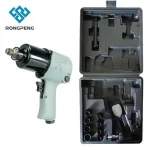

RONGPENG R-7488 Impact Wrench
Price on request
Overview
The injuries caused by impact wrenches are rarely dramatic. They are wrists, thumbs and shoulders, accumulated over months of holding a tool that delivers two hard blows per revolution while the operator takes the reaction through the arm. A buyer comparing two wrenches on torque alone is buying the one dimension that is easy to print and ignoring the one that decides whether the tool is still in use after a year.
Catalogue entry as listed: RONGPENG R-7488 Impact Wrench (reference R-7488). Drive size, weight and vibration figures are not on the record here, so they are listed among the items to confirm at the end rather than asserted above.
Materials and construction
Vibration reaches the hand through the housing, so a composite or rubber-overmoulded handle is a functional part rather than a styling choice. Mass distribution matters too: a tool with the mechanism forward of the grip feels steadier on a vertical joint but heavier when held overhead, and the operator compensates with the wrist. Balanced hammers and a well-supported anvil reduce the sharp component of the vibration without reducing torque.
The trigger housing is where the tool is gripped hardest, and a narrow or square section concentrates pressure on the palm. A trigger that can be operated by two fingers leaves the other fingers free to close around the handle, which is how the tool is meant to be held and rarely is.
How to select the right size and variant
Start with the working height. A tool used mostly at waist height can be heavier and more powerful; a tool used on ladders, under vehicles or overhead should be the lightest that will do the job, because weight held away from the body is what ends a shift early. Then look at the reaction path: a wrench with a forward handle or a reaction bar is safer on large fasteners than one that relies entirely on the operator’s grip.
Noise is the second exposure that buys a tool badly. Air motors exhaust at high velocity, and the exhaust note rather than the hammer is often the dominant source. An exhaust that can be rotated away from the operator, or fitted with a diffuser, changes the measured level at the ear noticeably. Ask for the noise figure at the operator position and for the vibration total value, and treat a supplier who cannot produce them as a supplier who has not measured.
Typical applications
Wheel and hub work in tyre bays. Overhead fastening on scaffolding and racking. Under-vehicle work on suspension and exhaust. Plant maintenance in confined engine bays. Assembly benches where a tool runs continuously and the operator’s exposure accumulates over a shift rather than in one job.
Standards and acceptance checks
Reaction torque is the acceptance question. With a socket fitted and the tool running in reverse against a tight joint, the tool should be controllable with the handle held square to the fastener; if it twists out of line, the operator will be fighting it all day. Check the trigger return with a glove on, the reverse control operation without repositioning the hand, and the exhaust direction with the tool held in the working posture rather than on a bench.
Then the exposure checks. Run the tool at working pressure for a minute and listen at the operator’s position rather than standing behind it; the difference is often several units. Check the vibration at the handle in each of the three axes if the figure matters for a health and safety assessment. Confirm that the socket is impact rated, that the joint is supported rather than held, and that air is disconnected before any change at the drive.
Packing, quantity and shipping
Tools in this class ship in a carton with a coupler and oil, sometimes in a case. For a buyer issuing tools to staff, the carton should carry the noise and vibration data on the outside or in a document packed with it, because the person doing the exposure assessment will not open the tool to find it. Confirm the inner-box quantity and whether a boot or a forward handle is included.
What to confirm before ordering
Confirm the drive size, the torque figures with their method, the free speed and the air consumption. Confirm the weight, the noise level at the operator position, and the vibration total value with the standard used. Confirm the handle and trigger arrangement, the exhaust control, whether a reaction bar or forward handle is available, the case, and the manual language.
| Model | R-7488 |
|---|---|
| Type | Impact Wrenches |
Reviews
There are no reviews yet.