
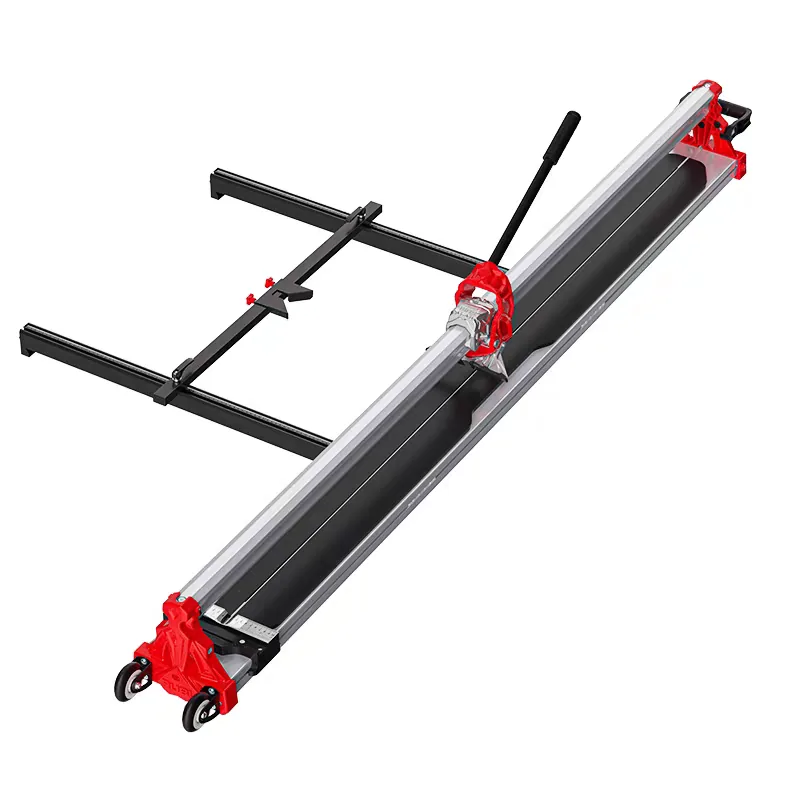
RUBI 1800 Tile Cutter
$252.99
What the largest frame in the range is for
The model is 1800, the longest bed in this family, and it exists for one reason: plank-format tiles and long skirting pieces that no shorter frame can carry. If your work is standard square tile, this is more machine than the job needs, and the extra length becomes a liability in a small room rather than an asset.
Bought for the right work, it removes the most common cause of wasted material on long formats, which is a cut that starts true and finishes a few millimetres out because the piece was never fully supported.
Footprint and the room you actually have
A bed this long needs clear space at both ends, not just at the sides. Working against a wall means the far end of the tile overhangs the frame with nothing under it, and the sag that follows is enough to spoil the score. Plan the cutting position before the tiles come into the room, because moving a frame of this size mid-job is a two-person operation.
Height matters as much as length. Set the frame so the bed is at waist level for the person scoring. Too low and you lean over the work, which shortens your reach and puts the pressure in the wrong place; too high and you cannot see the wheel track clearly.
Supporting the piece, not just the frame
Trestles at both ends, level with the bed, are not optional at this length. A long plank resting on a frame with unsupported overhang behaves like a spring: it stores energy while you score and releases it when the breaker comes down, and the release is what sends the break off line. Support the piece and the same technique produces a clean cut.
Cutting long planks without a second pair of hands
One person can score a long plank, but breaking it alone is where pieces get ruined. The second person does not need skill; they need to hold the far end flat and let go of any instinct to correct the break. Two people fighting a crack will always lose to it, and the piece will run out at the end that was being corrected.
Work from the centre of the score outward when breaking, and keep the pressure even. A long piece gives you more time to feel the crack travelling, which is an advantage if you are paying attention and a liability if you are rushing to get to the next cut.
Storage between jobs
Store it flat, on battens, with nothing stacked on top. This is the single instruction that decides whether the frame is still accurate in a year. A bed stored leaning against a wall takes a permanent set that no adjustment will remove, and the symptom is cuts that drift at the far end while the near end looks perfect.
Consumables and adjustment points
The scoring wheel and the breaker pad are the two parts that wear. Change the wheel when the score stops sounding consistent rather than when it stops cutting, because a dull wheel still marks the glaze while no longer cutting a groove deep enough to guide the break. The breaker pad should be checked for glazing and for a groove worn into one spot.
Check the carriage bearings for play at the same time. A carriage that rocks on the rail will produce a score of varying depth, and no amount of pressure control will compensate for it.
What to verify on delivery
Measure the bed diagonals. If they differ, the frame is not square and no adjustment of the guide will fix a twisted base. Then check the rail for straightness with a straight edge, and confirm the breaker descends evenly across its width rather than favouring one side.
Run a full-length cut on a scrap piece before the frame goes on site. A long frame that is out of true is difficult to diagnose on a job where every piece matters, and trivial to catch on a scrap tile in the yard.
| Model | 1800 |
|---|---|
| Type | Tile Cutters |
Related products
Reviews
There are no reviews yet.