


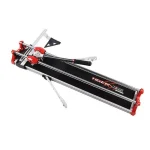
RUBI FONE1200 Tile Cutter
Price on request
The long-bed problem, stated plainly
The model is FONE1200, a manual scoring frame stretched to take the long formats that have replaced small ceramics in most commercial work. The bed grew; the physics did not. Every extra centimetre of rail is another centimetre that can flex, and every extra kilo of tile is another kilo your wrists carry while you try to keep the score dead straight.
That single fact explains most of what follows. A long manual cutter is not simply a bigger version of a short one. It is a tool whose success depends on how the piece is supported before the wheel ever touches it.
Handling comes before cutting
A long panel that is not supported along its length will sag under its own weight, and a sagging panel is already bent before you score it. Two people, a clean pair of trestles, and a straight edge under the piece solve more bad cuts than any amount of technique. Set the frame so both ends of the tile are carried, not so the middle is clamped and the ends hang.
Gloves matter here for a reason beyond comfort. A long porcelain edge is thin, sharp, and under load, and it fails without warning. Handling it bare-handed is the most common way a fitter ends a day early.
Scoring a long run without drift
Start at the near end with the wheel already in contact, then travel at one steady speed. Stopping halfway to reposition your grip leaves a hesitation mark, and the break will take that mark as an instruction. If the run is longer than your comfortable reach, move your feet rather than stretching, because a stretched arm changes the angle of the wheel to the rail.
Check the score line before breaking. On a long piece it is far cheaper to lift the tile off, wipe the rail and score again than to break and find the line wandering at one end after the piece is already cut.
Breaking sequence on long pieces
Long pieces break from the middle outward, not end to end in a single squeeze. Apply the breaker at the centre of the score, let the crack establish, then work toward each end. Squeezing at one end first loads the whole length through a single point and produces the classic diagonal run-out that ruins the piece.
Thin-format panels need a different approach again. They flex too much to break cleanly on a manual frame, and forcing the issue usually chips the face on the underside where you cannot see it until the tile is fixed.
Where a frame like this stops making sense
If most of your work is large-format porcelain with mitred edges, a manual frame is the wrong purchase no matter how good it is. Mitres and L-shaped cuts belong on a wet saw or a rail saw. A manual cutter earns its place on straight cuts in volume, and it should be bought for that job only.
Moving it between sites
A frame this length does not belong loose in a van. Stored flat on a clean surface it stays true; leaned against a wall or loaded under other tools it will slowly take a set, and a rail that is a millimetre out over its length is enough to make every cut drift at one end. If it must travel upright, brace it so the rail carries no weight.
Acceptance checks that catch a bent rail
Before you accept delivery, lay a straight edge along the rail in both directions and look for daylight at the centre. Then run the carriage the full travel and feel for a change in resistance. A tight spot in the middle of the run is the signature of a rail that has been dropped or stored badly, and it will not improve with use.
Finally, check the breaker alignment against the score line at both ends of the bed rather than only at the centre. A breaker that is square at the middle and out at the ends produces cuts that look correct until the piece is long enough to show the error.
| Model | FONE1200 |
|---|---|
| Type | Tile Cutters |
Reviews
There are no reviews yet.