
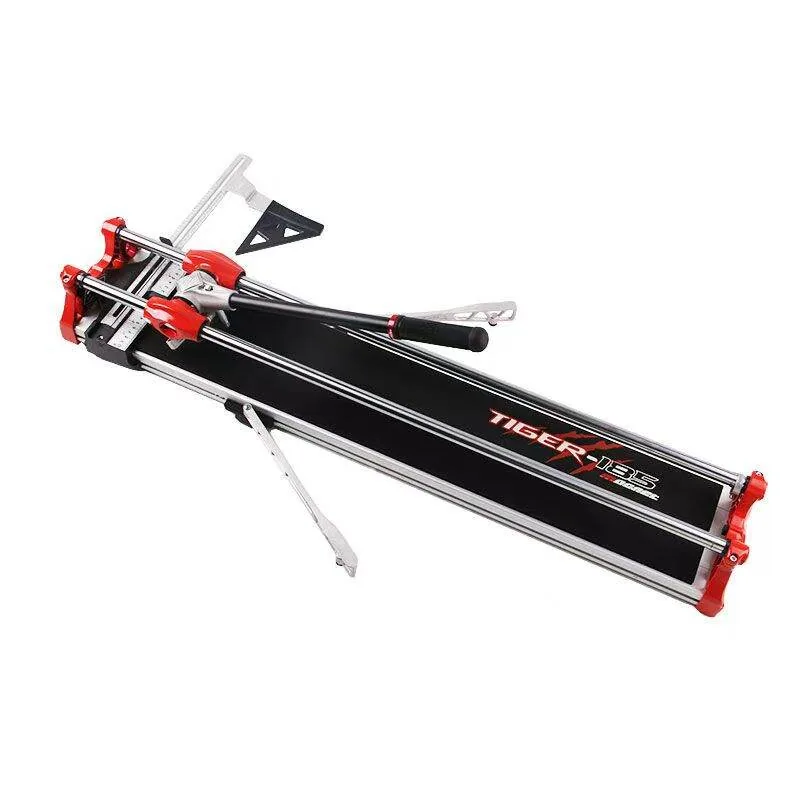

RUBI TIGER-1200 Tile Cutter
$117.99
Throughput on a commercial fit-out
The model is TIGER-1200, catalogued as a hand tile cutter, and the way to judge a tool like this on a commercial job is by throughput rather than by any single cut. A cutter that is accurate but awkward to feed costs more over a floor of tiles than one that is merely accurate, because the difference is paid on every piece.
Throughput on tiling work is decided by three things that are not the cutting mechanism: how quickly a piece can be positioned against the stop, how easily the cut piece can be lifted away, and how far the operator has to walk between the cutter and the bed. A tool that wins on all three will beat a better cutter every time.
Batch the cuts, then lay
The biggest gain on any tiling job comes from separating cutting from laying. Cut a full run, stack it in the order it will be laid, and then bed it without leaving the area. Doing it the other way, cutting one piece at a time as you go, means walking to the cutter for every tile and losing the rhythm that makes bedding fast.
Stack cut pieces face to face and back to back rather than face to face throughout. Glazed surfaces are the part that shows damage, and a stack arranged this way has half as many surfaces at risk.
Positioning against the stop
The stop is the part of the setup that decides repeatability. Set it once, cut three pieces, and check them against a square rather than against each other. Then check the fourth piece after the tenth cut, because stops move by increments under repeated pressure and the movement is silent.
Keep the bed of the cutter clean. Adhesive and grit under the tile lift it off the bed, and a piece that is lifted at one end cuts with a taper that is invisible until it is laid.
Recording waste
Keep a tally of pieces cut against pieces broken or rejected for a week. Most tiling waste is not the material’s fault and is not random: it concentrates on one type of cut, one size of piece, or one part of the day. A tally makes that visible in a way that memory does not. Once the pattern is visible, it is usually fixable with a change of technique or a change of order of work rather than with a new tool.
Working with large formats
Large pieces need support at both ends and a second pair of hands for lifting. A piece that sags while being scored will break off line no matter how carefully the cut was set up, and the failure appears at the far end where nobody was looking.
If most of the work is large format, a hand cutter may not be the right tool at all. That is a question about the work rather than about this machine, and it is worth answering before a floor is scheduled.
The setup between jobs
When the cutter moves between rooms, check the frame for square and the rail for straightness before the first cut. A tool that has been carried through a doorway has been bumped, and a bump that takes a frame out of square is not visible until cuts start running out at one end.
Keep the scoring wheel and the breaker pad in a small box with the cutter rather than loose in a bag. Both are small, both are essential, and both are the parts that go missing between jobs.
Acceptance and first cuts
Check the rail with a straight edge, check the breaker descends squarely, and confirm the stop locks firmly at each position. Then cut scrap of the material you will be laying, not of whatever is to hand. A cutter that performs on scrap of the right material is a cutter that will perform on the floor. Anything less is an assumption, and assumptions about cutting tools are usually paid for in material.
| Model | TIGER-1200 |
|---|---|
| Type | Tile Cutters |
Reviews
There are no reviews yet.