
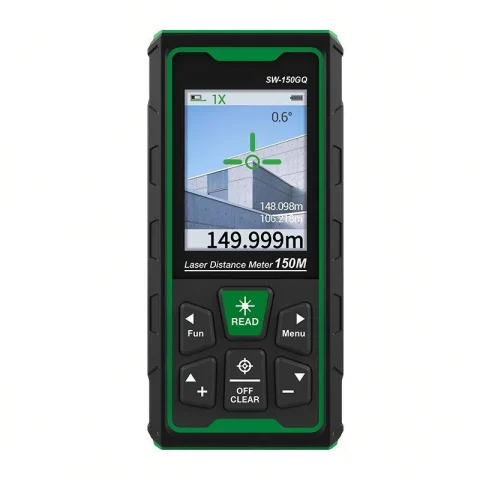
SNDWAY H-D100G Laser Distance Meter
Price on request
Overview
Most measuring on a refurbishment goes wrong at the corners, not in the middle of a wall. A tape held into a corner bends around the skirting, a doorway interrupts the run, and a room that measures clean on paper turns out to be out of square by the width of a finger. A hand-held meter answers those cases because it can be placed against one surface and fired across the room without anything to hook onto at the far end.
Catalogue entry as listed: SNDWAY H-D100G Laser Distance Meter (reference H-D100G). The file carries the model reference only, so range, tolerance and the presence of an angle sensor are left to the confirmation list, and the paragraphs below stay with what is true of the class.
Materials and construction
The shell is normally a two-shot moulding: a rigid inner frame in glass-filled nylon and a softer outer band that survives being set down on aggregate. The optics sit behind a window that is recessed slightly and sealed with a gasket on units built for outdoor work, since a single grain of grit on the emitter lens will scatter the beam and shorten usable range. Buttons are sealed domes, and the display is usually a segment LCD chosen for sunlight legibility rather than for resolution.
The battery compartment is the weak point on cheap meters: a leaf-spring contact loses tension and the unit resets mid-measurement, losing the reading and any stored value. Better designs use a captive screw and a foam pad behind the cells.
How to select the right size and variant
Work backwards from the worst case on site rather than the typical one. The longest diagonal in a building, the height of a stairwell and the distance across a warehouse floor all exceed the wall-to-wall figures a buyer quotes when ordering, and a meter used outside its comfortable band returns readings that look plausible and are wrong. Then take the tolerance the trade lives with — a flooring contractor and a glazing contractor do not need the same figure.
The rest is about how the reading gets captured. Continuous mode is what allows one person to walk a room; single-shot mode is what allows a careful reading against a target plate. Area and volume functions save arithmetic but only if the datum is set correctly, and a unit that displays the datum on screen saves more errors than one that hides it in a menu.
Typical applications
Surveyors measure ceiling heights and room diagonals to check square. Flooring contractors build a metre-per-square figure without a second person. Fire and security installers measure detector spacing and cable runs against a drawing. Window and blind fitters measure reveals where a tape cannot sit flat. Warehouse staff measure racking bays and aisle widths for layout planning.
Standards and acceptance checks
Check three things on arrival. Compare a reading against a steel tape over a known distance of several metres and note the difference; a meter that reads consistently short by the length of its own body has a datum set wrongly rather than a fault. Then fire at a white wall in poor light and confirm the display is readable and the reading repeatable. Finally, drop the unit a short distance onto a bench and repeat the first check, because optical alignment after a knock is the failure mode that matters.
Laser safety is straightforward but not optional: the beam belongs to a class that must not be aimed at anyone’s eyes or at mirrors and glass at face height, and a unit stored in a van should have its cells removed if it will sit for months.
Packing, quantity and shipping
Meters ship in a printed carton with a pouch, a strap and cells. Export cartons for retail programmes need a hang tag and a barcode that the destination retailer accepts, and the cell type decides whether the carton needs lithium marking. Confirm the inner-box count early, because a pouch that is packed loose adds carton volume across a pallet.
What to confirm before ordering
Confirm the range and the tolerance with the conditions they were measured under, the datum options and whether a target plate is included, and whether an angle or level function is present. Confirm the battery format and whether cells ship inside the unit. Confirm the display type, the unit default and lock, the pouch, and the manual language.
| Model | H-D100G |
|---|---|
| Type | Laser Distance Meters |
Reviews
There are no reviews yet.