
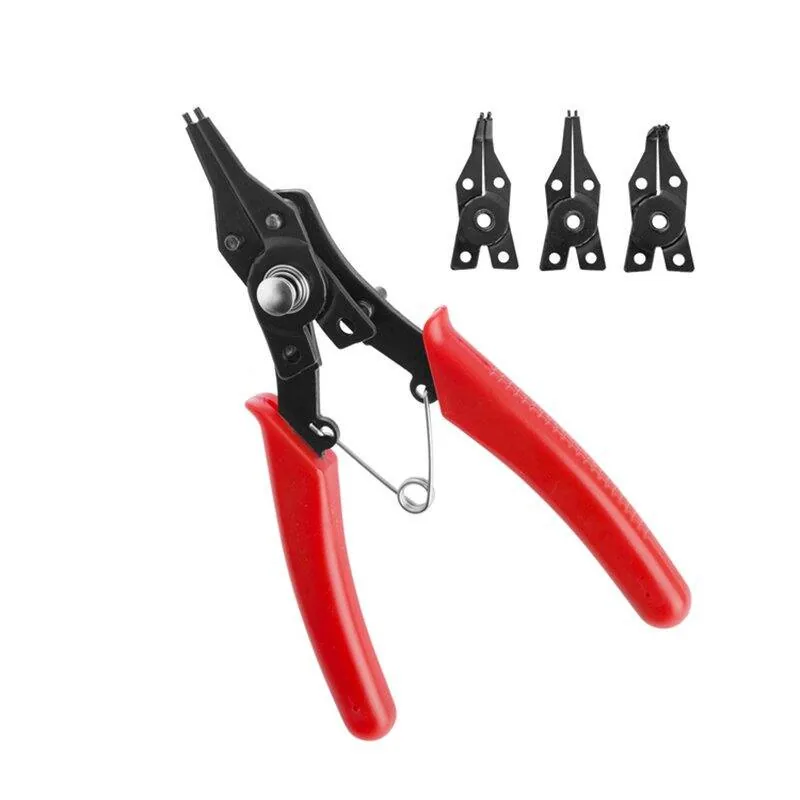
WORKPRO Circlip Pliers
$3.99
Why circlip pliers come as a pair, not a tool
A circlip is a split ring seated in a groove, and it can face two ways: opening outward against a bore, or inward against a shaft. The same plier cannot do both, because the jaws must either spread apart under squeeze or close together under squeeze. That is why the class is sold as internal and external, and why buying one and expecting both is the most common mistake in this category.
Each type also comes in a range of tip sizes. A plier whose tips are too small for the ring will slip out under load and round the lug holes, and once a lug is rounded the ring has to be destroyed to remove it.
Jaw tips, spring and the return
The tips are the consumable. They are hardened, they are small, and they take the entire load of compressing a spring-steel ring. On a good plier the tips are replaceable or at least regrindable; on a cheap one they are formed from the jaw itself and the tool dies with them.
The spring and the return action decide how the tool feels over a hundred rings. A plier that must be opened by hand after every squeeze will slow a job visibly, and the effort goes into the wrist rather than the ring. Look for a return spring that is enclosed rather than a wire loop sitting where it can be snagged.
What the registry holds here
We record the model, the SKU and the price on this page. The critical attributes for this class, namely internal or external action, tip diameter, tip angle and the ring size range, are not in our data. That is the gap a buyer must close before ordering, and it is not a gap we will paper over with an assumption.
The model string identifies the line. It does not tell you which way the jaws move, and no photograph taken from above will tell you either, because the difference only shows when the handles are squeezed.
Internal work against external work
Internal pliers are used where the ring sits inside a bore: gearbox housings, bearing seats, cylinder bores and hub assemblies. External pliers are used where the ring grips a shaft: pivot pins, wheel bearings, linkage joints and retaining grooves on axles.
In practice a workshop needs both, and needs them in the sizes its equipment actually uses. Buying one pair of each in a mid-size and discovering that half the fleet uses a smaller ring is a normal outcome of buying by price rather than by size range.
Tip fit checks we run
We open and close the plier through its full travel and check the tips meet squarely, with no overlap and no gap that would let a lug slip between them. Then we check the tip diameter against a gauge, because a tip ground down by a previous user will still look correct in a photograph.
The spring is cycled twenty times and watched for a change in return speed. A spring that weakens during a bench test will fail in service, and the failure is usually a ring that will not release because the plier will not open.
Packing and the tip problem
Circlip pliers ship with a tip protector, and the protector matters: a hardened tip that takes a knock in transit will chip, and a chipped tip will not seat in a lug. Cartons are small and light, so freight is rarely the issue and damage in transit usually is.
Where several sizes ship together, each pair is bagged separately with its size marked. Loose pliers in one carton are indistinguishable by feel, and a mixed bag at goods-in means a fitter discovers the wrong size with a ring half compressed.
Confirmations before the order
Ask for the action type, the tip diameter, the tip angle where it is not straight, and the ring size range the plier covers. Ask also whether tips are replaceable, because that single answer decides whether the tool is a purchase or a consumable.
If you are restocking for a workshop, send us the ring sizes your equipment uses and we will size the order around them. Buying by range rather than by model number is what keeps a drawer of pliers actually usable.
| Model | WP201004 |
|---|---|
| Size | 155 mm (6 in) |
| Type | 4-in-1 circlip pliers set |
| Material | 65Mn steel |
Reviews
There are no reviews yet.