
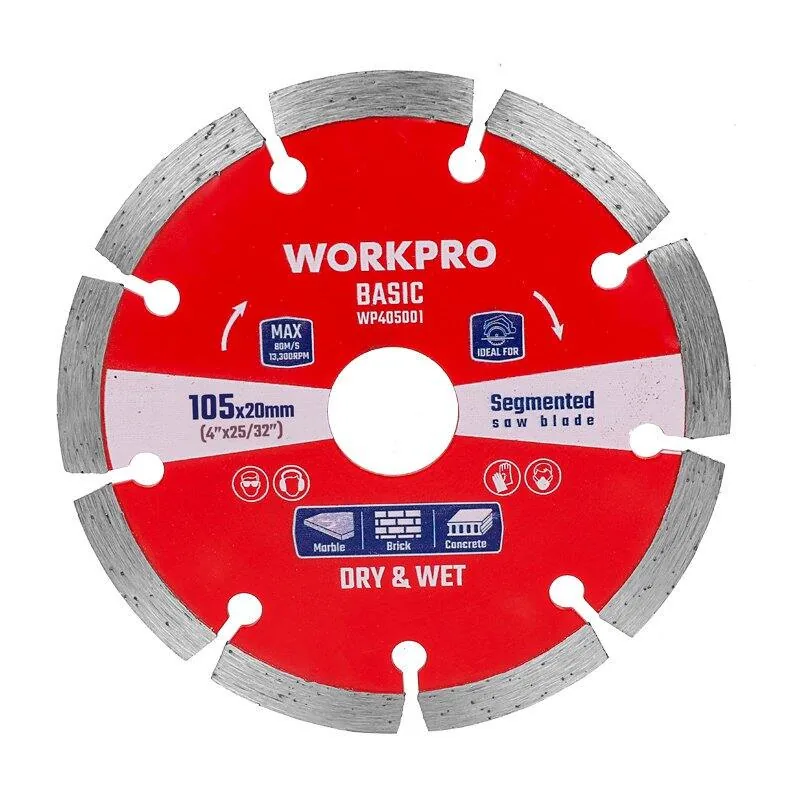

WORKPRO Saw Blade 105x20x7mm
$1.99
Overview
A circular saw blade is a consumable that decides the quality of a cut more than the saw does. The machine only supplies speed and rigidity; the blade supplies tooth geometry, set and sharpness, and those three decide whether a cut leaves a polished edge or a torn one. Buyers who replace a blade without reference to tooth count usually discover the difference on the first sheet of veneered board.
Catalogue entry as listed: WORKPRO Saw Blade 105x20x7mm. The registered size is 105x20x7 mm, and that is the only dimensional record on the file. How the three figures map to diameter, bore and plate or kerf is treated as a confirmation item below rather than assumed here, because a bore read wrongly will not fit the saw.
Materials and construction
A blade in this size class is a steel plate, usually laser cut and then tensioned, with tungsten carbide tips brazed into seats machined on each tooth. The plate carries expansion slots cut in from the rim and sometimes a filled groove around the body; both exist to let the plate grow as it heats without going out of true. Tip brazing quality decides how long a tooth stays on, and a blade that throws a tip is a blade that was run too hot or brazed badly.
Tooth geometry is where the design lives. A ripping tooth has a flat top and a deep gullet to clear waste; a crosscut tooth is filed at an alternate bevel to shear fibres; a triple-chip tooth is a square raker with bevelled corners and is what most blades for aluminium and plastic use. The hook angle, the rake of the tooth face, sets how aggressively the blade feeds.
How to select the right size and variant
Diameter and bore must match the saw and its flange, and bore adaptors are a compromise because a loose ring can let the blade run off centre. Tooth count then follows the material: fewer teeth clear waste faster in thick softwood, more teeth leave a cleaner edge in trim and laminate but cut slower and heat faster. Kerf, the width of cut, has to be matched to the saw’s riving knife or splitter on machines that have one.
For a buyer running small saws on site, the practical question is whether one blade has to do everything. A general-purpose blade with a moderate tooth count and a thin kerf is the usual compromise, and a second blade kept for finish work is what actually protects the cut quality.
Typical applications
Trim carpenters cut skirting, architrave and moulding where the edge is visible. Flooring installers cut laminate and engineered board and cannot afford chipped faces. Shopfitters cut plywood and MDF for carcasses and counters. Metalworkers cut aluminium profile and composite panel with a triple-chip blade on a suitable saw. Maintenance teams cut sheet material for repairs and boxing.
Standards and acceptance checks
Three checks settle a delivery. Flatness and runout: fit the blade, spin it by hand and watch the rim against a fixed point; a wobble that repeats once per revolution is a bent or badly tensioned plate. Tip integrity: inspect every tooth for a missing or chipped tip and for braze that has spread onto the face. Bore fit: the blade should sit on the flange without rocking and the arbor washer should clamp evenly, not on the tips of the teeth.
Safety around blades is mostly about what is fitted around them. The guard must be in place and free to return, the riving knife must align with the kerf, and the blade must never be run above the speed marked on it. Eye and hearing protection are baseline, and a blade that has been overheated should be discarded rather than resharpened, because the temper has gone.
Packing, quantity and shipping
Blades ship in a cardboard sleeve or a plastic case with a tooth guard. Bulk orders ship in inner boxes of ten or so with the teeth protected by a plastic ring, because a blade that rubs against another in a carton loses tips before it is used. Confirm the inner-box count and whether individual sleeves are wanted for retail display.
What to confirm before ordering
Confirm which of the three recorded dimensions is diameter, which is bore, and which is plate thickness or kerf, and confirm the bore tolerance. Confirm the tooth count and geometry for the material, the hook angle, and the maximum speed marked on the blade. Confirm whether the blade is for wood, aluminium or composite, the packaging format, and the marking on the sleeve.
| Model | WP405001 |
|---|---|
| Type | Saw Blades |
| Size | 105x20x7mm |
Related products
Reviews
There are no reviews yet.