
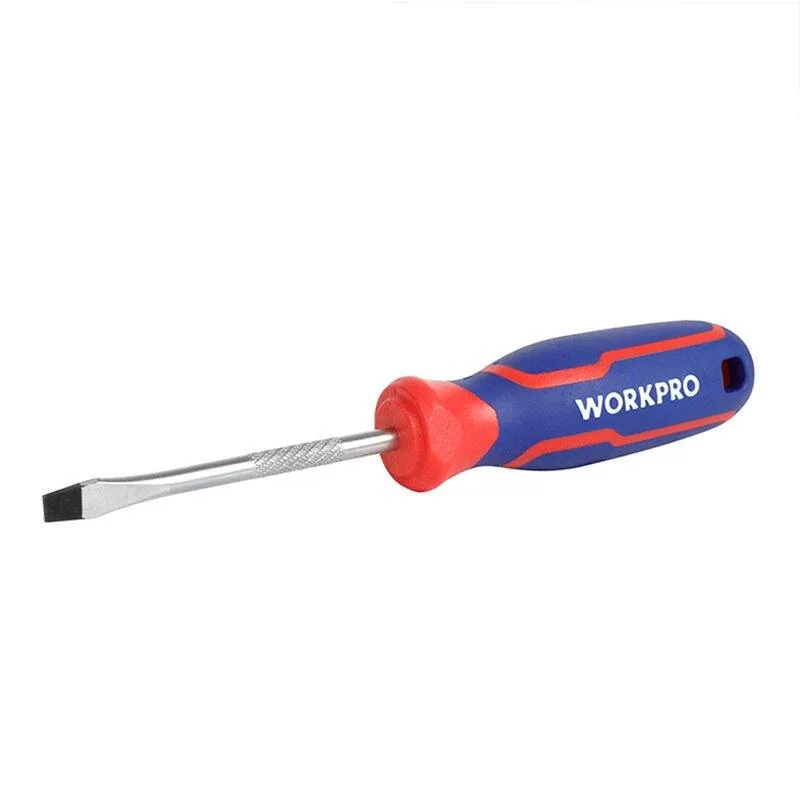
WORKPRO Screwdriver 5.5x100mm
$1.99
Overview
The two figures on a screwdriver are its tip width and its blade length, and both are frequently misread. The width has to match the slot in the screw head, and the length has to match the depth of the recess and the space around it. A driver that is too narrow for the slot concentrates load on a thin section of the screw head and chews it out; a driver that is too long will not fit through a hole in a panel to reach the fastener behind it.
Catalogue entry as listed: WORKPRO Screwdriver 5.5x100mm. The registered size is 5.5×100 mm, and that is the only dimensional record on the file, so the tip type and the handle format are confirmation items.
Materials and construction
The blade is a hardened steel bar, usually chrome vanadium for general work and a higher-grade alloy where torque is high. The tip is formed, then hardened and tempered, and often given a treatment that improves grip on the screw: a sandblasted face, a slight hollow grind, or a ribbed pattern that bites into the slot. Each of those works only if the tip fits the slot properly, which is why a well-made tip in the wrong size performs worse than a plain tip in the right one.
The handle carries the torque. A hexagonal bolster near the handle lets a spanner be used on stubborn fasteners without splitting the handle, and a hole through the handle end allows a bar for extra leverage. Both features are common on drivers intended for slotted screws, because slotted heads transmit torque poorly and often need more force than a hand can apply.
How to select the right size and variant
Measure the screw slot rather than guessing. The blade width should fill the slot from side to side, and the thickness should fill its depth, so that the load is carried by the flanks of the slot rather than by the surface. In practice a driver slightly narrower than the slot is safer than one slightly wider, which will not seat and will damage the head as it turns.
Length follows the access. A short blade reaches fasteners in a recessed panel but gives less control; a long blade reaches through a clearance hole and keeps the hand away from the surface, at the cost of a tendency to cam out when the screw is tight. For a buyer equipping a bench, two lengths of the same width cover both cases and cost less than a set with sizes nobody uses.
Typical applications
Electrical terminal work, where screws are small and the access is behind a cover. Furniture and cabinet assembly, where the screw heads are often soft and easily damaged. Appliance and equipment maintenance, where a fastener sits at the bottom of a recess. Automotive trim and interior fittings, where a long thin driver reaches behind a panel. General hardware work on hinges, catches and latches.
Standards and acceptance checks
Test the fit on the screws the buyer actually uses. Seat the tip, apply torque in both directions, and watch for movement at the tip; any rocking means the wrong size, not a faulty driver. Check the tip under light for a clean edge and a flat end, since a rounded or chipped tip will cam out and damage the head. Then check the handle joint by twisting firmly, and check the handle for moulding seams that will blister a hand during a long session.
A screwdriver is not a chisel or a pry bar, and using it as one is how tips snap and how hardened fragments travel. Where a fastener is seized, the correct answer is a penetrant and time, or a driver with a bolster and a spanner, not more force through the handle. Insulated drivers must be marked and used only where their rating covers the circuit being worked on.
Packing, quantity and shipping
Individual drivers ship carded or in plain inner boxes, and bulk orders are usually supplied without cards so that the buyer can rack them. Confirm how the tip size is marked, because a driver that loses its marking becomes an anonymous tool in a drawer and is replaced rather than used. Confirm the inner-box quantity and whether a display stand is available.
What to confirm before ordering
Confirm the tip width, the blade length, and the tip type, and confirm that the recorded dimensions refer to width and length in that order. Confirm the blade material and the tip treatment, whether a bolster and handle hole are present, and whether the driver is insulated. Confirm the handle material and colour, the marking method, and the packaging format.
| Model | WP221016 |
|---|---|
| Type | Screwdrivers |
| Size | 5.5x100mm |
Reviews
There are no reviews yet.