


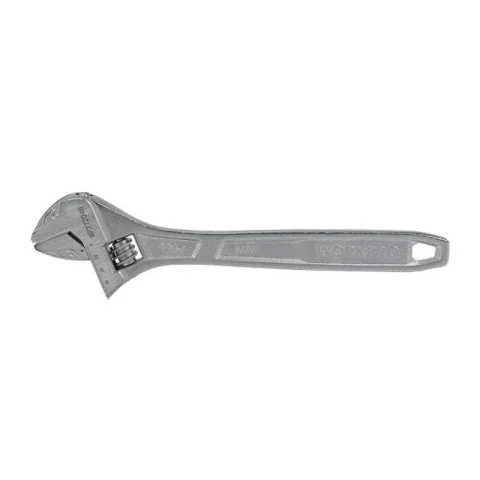
WORX WU279.3 Wrench
Price on request
When it misbehaves: symptoms and causes
Symptoms first and teardown last is the sequence that keeps a wrench out of the parts bin and its paperwork intact. Check the jaw travel through its full range before the first job; a wrench that binds at one end of its travel has a burr that will spread with use.
Start every wrench investigation with the cheapest question, is it clean, and end with the dearest one, is it worn; the answer usually lives at the cheap end. Work a wrench fault from the outside inward: grip, edge, joint, then the parts nobody wants to disturb on a live job. Give a wrench fault the witness treatment, who ran it, on what, for how long; the story behind the symptom removes half the possible causes by itself. What separates a wrench that lasts from one that does not is rarely the specification on the label; it is whether anyone wrote down what happened last time.
The entry on the books
Catalogue entry as listed: WORX WU279.3 Wrench (reference A0010362). The listing files under Hand Tools, and leaves pricing quoted per order rather than printed. No size line appears in the record, so the text invents none.
Choosing between the alternatives
Between the wrench options a buyer actually has, the axes that decide are load, reach and the cost of keeping them sharp. It suits general assembly and maintenance where a single adjustable tool has to cover a range of fasteners rather than one size.
A sensible wrench comparison weighs the tool against the diary rather than the brochure; the best spec on paper loses to the right size on the belt. Treat the wrench as a tool with a schedule rather than a tool with a price, and the schedule is what keeps it on the bench instead of in a bin.
Procurement notes for the buyer
The buying rule for a wrench that survives contact with sites: one in the work, one in the box, and the box labelled. Hang it rather than laying it in a drawer; a wrench that shares a drawer with files and drills loses its adjustment to knocks.
A shelf policy that labels, dates and rotates wrench stock beats a larger budget; the cheapest tool is the one already on the shelf when the job calls. Whatever the wrench is asked to do, the asking is easier when the tool is where it belongs and known to be sound.
How tools of this class usually die
Ask any repair bench what kills a wrench and the answer is a short list, told with more amusement than sympathy. The obituary of a wrench is usually written months before the funeral, in small abuses that nobody logged at the time. A wrench rarely dies of old age on a well-run site; it dies of a habit that somebody thought was a shortcut. A jaw that slips under load is worn teeth or a bent screw, and the two are told apart by whether the slip happens in one direction only. The wrench tolerates neglect for a while and then presents the bill in one lump, which is why the small habits are worth more than the large repair.
Repair, replace or retire
Repair or replace is a weekly question for a wrench, and it deserves arithmetic rather than sentiment. The screw and the jaw are replaceable on most of these; a handle that has been used as a hammer is the end of the tool, not a service item.
Keep a borderline wrench alive on bench duty rather than on critical work; the second failure always arrives at the worst moment of the job. A note on the wrench shelf costs a minute and replaces an argument that would otherwise be held from memory on a busy morning.
How this page was written
Everything factual on this wrench page is drawn from the catalogue entry and the library record; the technique passages are standard trade craft, not specification. A note on the wrench shelf costs a minute and replaces an argument that would otherwise be held from memory on a busy morning.
Anything the record does not state about this wrench, the page does not invent; a written specification can be requested from the desk. Treat the wrench as a tool with a schedule rather than a tool with a price, and the schedule is what keeps it on the bench instead of in a bin.
| Model | WU279.3 |
|---|---|
| Type | Wrenches |
Reviews
There are no reviews yet.