



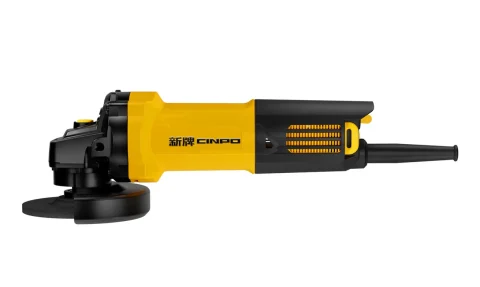
WORX WU900S Angle Grinder
Price on request
Overview
The disc on an angle grinder is chosen for the task, not for the machine, and getting it wrong is the most common cause of a grinder injury. A cutting disc is thin, reinforced for edge load and built to be used on its rim; a grinding disc is thick, built for face load and will shatter if it is used to cut. The two look interchangeable on the spindle, and they are not.
Catalogue entry as listed: WORX WU900S Angle Grinder (reference WU900S). Disc diameter and spindle thread are not on the record, so they are confirmation items, and the notes below deal with abrasives and mounting rather than with the machine’s figures.
Materials and construction
A bonded abrasive disc is a mat of grit held in resin or vitrified bond, with fibreglass reinforcement layers for strength. The reinforcement is what allows the disc to survive the centrifugal load at working speed, and the markings on the disc record the maximum speed, the dimensions and the intended use. A depressed-centre disc has a raised hub so that the locking nut sits below the grinding face; a flat cutting disc has no hub and must not be used for face grinding.
A diamond blade is a steel core with diamond segments brazed to the rim, and a flap disc is overlapping abrasive cloth on a backing plate. Each has a different failure mode: a bonded disc bursts, a diamond core bends and loses segments, and a flap disc sheds cloth when it is run above its speed.
How to select the right size and variant
Match the disc diameter to the tool, never the other way round. A disc larger than the guard will not fit; a disc smaller than the tool is inefficient but safe. Then match the grit and type to the material: a coarse disc removes material fast and leaves a scratched surface, a fine one polishes slowly and loads up on soft metal, and a contaminated disc — one that has been used on aluminium and then on steel — will embed particles and tear the steel surface.
Thickness decides behaviour within a category. A thin cutting disc cuts quickly with little heat but is fragile in edge load; a thicker one lasts longer and wanders less. For a buyer stocking a workshop, the practical answer is a small range of clearly marked discs and a rule that discs are stored flat, dry and away from oil, because a disc that has absorbed oil loses strength invisibly.
Typical applications
Cutting rebar, threaded rod and steel section on site. Dressing welds and removing spatter in a fabrication shop. Grinding rust and paint from plate before welding. Cutting and chasing masonry with a diamond disc. Finishing stainless with a flap disc to a brushed appearance.
Standards and acceptance checks
Check every disc before it goes on the tool. Look for a missing chunk, a crack at the hub, damp staining on a bonded disc, or a bent core on a diamond blade; any of those means discard, not use. Check that the marked maximum speed is at or above the tool’s no-load speed, and check the blotter and flange are present and undamaged. Then run the tool with the guard fitted for a few seconds before applying it to the work.
The mounting rules are absolute. The locking nut goes on the correct way for the disc type, the flange diameters must match, and no disc should be mounted without its blotters. A disc must never be tightened with a hammer or a chisel, and the spindle lock must only be engaged when the tool is stopped. For cutting, the guard must be a cutting guard, and the operator must stand to one side of the plane of the disc rather than in line with it.
Packing, quantity and shipping
Abrasives ship in boxes with the discs separated, and bonded discs should travel flat rather than on edge. For export, the carton must keep the discs dry, since moisture attacks the bond and the damage is invisible until the disc is run. Confirm the inner-box quantity and whether individual discs are sleeved for retail sale.
What to confirm before ordering
Confirm the disc diameter and bore that the tool accepts, the spindle thread, and the guard type supplied. Confirm the no-load speed so that discs can be specified above it. Confirm the abrasive types and grits available, the packaging format, whether a carrying case is included, and the manual language.
| Model | WU900S |
|---|---|
| Type | Angle Grinders |
Related products
Reviews
There are no reviews yet.