

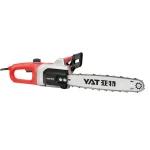
YAT YT4376 Electric Chainsaw
Price on request
Overview
Chainsaw injuries happen in a predictable order: the nose of the bar touches something it should not, the saw kicks upward and back, and the hand holding the front handle is thrown toward the chain. Every safety feature on a modern saw is a response to that sequence, and every one of them can be defeated by an operator who holds the saw one-handed or who has disabled the brake because it kept tripping.
Catalogue entry as listed: YAT YT4376 Electric Chainsaw (reference YT4376). The file records the model reference only; the power source is treated as a confirmation item rather than assumed, and the notes below describe electric saws of this class.
Materials and construction
The safety architecture is mechanical and worth understanding before buying. The front guard is the manual and inertial brake handle: pushed forward by the wrist in a kickback, it wraps a band around the clutch drum and stops the chain. The rear handle carries a throttle interlock so that the saw cannot be started with one hand on the trigger. The chain catcher below the sprocket is a small steel peg that catches a thrown or derailed chain before it reaches the operator’s hand.
Vibration mounts separate the handles from the engine or motor body; on a saw that has been dropped, these mounts crack and the vibration at the hands rises sharply before anything else fails. The spiked bumper at the front of the body is a working part, not decoration: it gives the saw a pivot against the wood and reduces the load the operator carries in the arms.
How to select the right size and variant
For a buyer who will cut occasionally, the saw should be the smallest that covers the largest log, because a light saw is a safer saw in untrained hands. For a professional, the saw is chosen for the wood and the day’s volume, and the safety features are non-negotiable rather than optional extras. In both cases, the chain brake must be reachable from the front handle without moving the hand, and the throttle interlock must work with a gloved hand.
Then consider the working environment. A saw used near buildings and vehicles needs a short bar and a sharp chain, because both reduce the effort of the cut and the chance of a kickback. A saw used on a slope needs a stable footing and a plan for where the cut piece will go; that is a method question, but it decides bar length.
Typical applications
Tree surgery and arb work, where the saw is used at height and every gram of weight matters. Grounds maintenance on estates and parks. Firewood production where the operator cuts daily and the saw is the main tool. Utility and highway crews clearing windblown timber from roads and lines. Farm work on hedgerows, fence posts and fallen branches.
Standards and acceptance checks
Test the brake on delivery, and then test it at the start of every session. With the saw running at working speed, push the guard forward: the chain should stop at once, and the guard should return to its rest position when released. Test the inertial function by holding the saw by the rear handle and letting the nose drop onto a soft block; the brake should trip without the guard being touched.
Then check the parts that hold the operator. The chain catcher should be present and unbent, the spiked bumper should be fixed and sharp enough to bite, and the anti-vibration mounts should be intact at both handles. Cut-resistant trousers or chaps, boots, eye protection, hearing protection and a helmet with a visor are required, and the saw should never be used above shoulder height or with one hand. A saw that has been dropped should be examined before it is used again, because a bent bar or a cracked mount is not always visible at a glance.
Packing, quantity and shipping
Saws ship with the bar protected by a scabbard and the chain tensioned loosely for transport. Retail cartons carry the safety information; export cartons for trade buyers often do not, so the buyer should specify a manual in the destination language and a warning label on the body rather than on the carton. Confirm whether the chain is fitted at packing, since a fitted chain travels better than a loose loop.
What to confirm before ordering
Confirm the power source and supply requirements, the bar length and chain specification, and whether a spare chain is included. Confirm the brake type and that the inertial function is present, the presence of a chain catcher and spiked bumper, and the anti-vibration arrangement. Confirm the manual language, the safety labels required, the scabbard, and the carton marking.
| Model | YT4376 |
|---|---|
| Type | Electric Chainsaws |
Related products
Reviews
There are no reviews yet.