
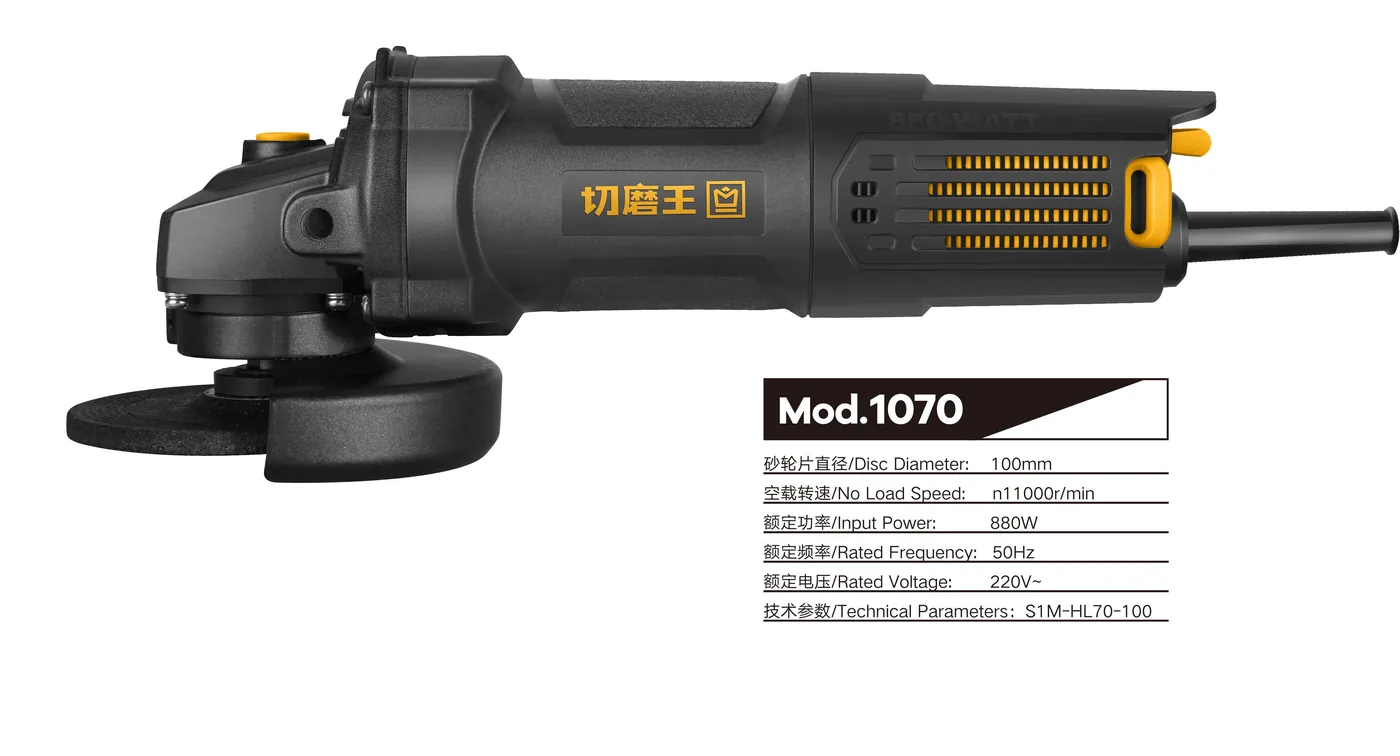

QIEMOWANG 1070 Angle Grinder
$16.99
Buying a set of tools rather than one good one
The model is 1070. The purchasing problem it belongs to is a familiar one: a crew has a budget that will buy either one premium grinder or three of these. For most small operations the three are the better buy, and the reason is not quality but queueing.
A single grinder shared by three people is a tool that is always somewhere else. The real cost of that is not the walk to find it; it is the habit of doing a job with the wrong tool because the right one is in use, which is how discs get ruined and edges get burned.
Matching the tool to the task, not to the catalogue
Sort the work into cutting, grinding and finishing before buying anything. Cutting wants a tool that is light and controllable; grinding wants mass and sustained torque; finishing wants speed control. One grinder asked to do all three will do none of them well, and the compromise shows up in the finish.
With several units available, assign each to a role and keep it there. A grinder that stays set up for cutting saves the disc changes that otherwise happen ten times a day, and disc changes are where most damage to flanges and spindles occurs.
Identical units simplify everything
Buying the same model for the whole crew means one set of spares, one disc fitment, one training conversation and no arguments about which tool is whose. It also means that when one unit fails, another can be cannibalised or swapped without the operator noticing a difference in behaviour.
Mixed fleets look efficient on paper and are exhausting in practice. If a second, different tool is needed for a specific job, keep it visibly different so that nobody expects it to behave like the others.
A maintenance rotation that actually happens
Tools in a shared kit are nobody’s responsibility unless it is written down. A simple monthly rotation, in which each unit is inspected, blown out, and its cable checked, catches the failures that would otherwise appear mid-job. It takes under an hour for a small fleet.
Record what was found, not just that the check happened. A cable that has been noted twice as cracked is a cable that will fail, and the record is what turns a vague intention into a repair order.
Consumable standardisation
Standardise disc grade across the fleet and keep the boxes labelled by operation. When the same disc is used for cutting and grinding, it is used badly for both, and the cost appears as a finish that will not take paint and a disc that has to be replaced early. Buy discs in the grade the work actually needs rather than the cheapest available. The difference per disc is small; the difference in how many are consumed is not.
What breaks when a cheap tool is the only tool
The failure mode of a low-cost grinder is predictable: it is asked to do continuous work because there is nothing else available, it overheats, and it fails within a season. The tool is then judged unreliable, when in fact it was used outside the duty it was built for.
Several units, each used within its envelope, will outlast one unit used outside it. That is the entire argument for buying a set, and it holds regardless of which tool is chosen.
Incoming checks for a batch
Check every unit, not just the first one out of the box. Open each, confirm the guard and handle, run it unloaded, and listen. Batches occasionally contain one tool that was assembled differently, and it is much easier to find that on arrival than after it has been issued. Record serial numbers against the issue list. On a fleet of identical tools, the record is the only way to know which unit has been to the repairer twice.
| Model | 1070 |
|---|---|
| Type | Angle Grinders |
Related products
Reviews
There are no reviews yet.