

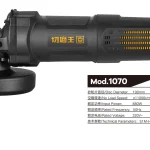

QIEMOWANG HLG1-100 Angle Grinder Brushless
Price on request
Electronic protection is the part you cannot see
The model is HLG1-100, a brushless grinder, and the significant difference from a conventional tool is not the motor alone but the electronics between the motor and the switch. In this class of tool those electronics commonly include some form of overload and thermal protection, which changes failure from a sudden event into a refusal.
That refusal is a feature. A tool that cuts out when it is being abused is telling you the abuse happened, and an operator who resets it and continues has learned nothing except that the protection works. Most electronic failures on grinders follow a period of exactly that behaviour.
Repair economics over a five-year horizon
The purchase comparison that matters is not the ticket on the day but the total over the working life. A conventional grinder consumes brushes, and each brush change is a bench job with a labour cost attached; a brushless tool has no such interval but carries electronics that are not repairable in a workshop.
The break-even point depends on hours, not on years. A tool that runs two hours a week will likely never pay back the brushless premium through brush savings. A tool that runs six hours a day will, and it will do so well before the electronics become the question.
What soft start protects, when it is fitted
Many tools in this class use a controlled ramp at start-up rather than a direct connection of the motor to the supply. In practice that reduces the kick an operator feels when the switch is pressed, and it removes the start-up surge that a long extension lead turns into a voltage dip.
It also protects the tool from its own user. A grinder that starts instantly invites the habit of switching on before the disc has cleared the work, and that habit is responsible for more chipped disc edges than any material fault.
Heat is the limit, not power
Every grinder in this class is limited by how fast it can shed heat, and the electronics are more sensitive to that limit than the windings are. Working in a confined space, with the air outlet blocked by your own arm, is the condition that ends motors early and it is invisible from the outside. Let the tool run free for a few seconds after a long cut rather than switching off immediately, so the internal fan clears the hot air. It is a small habit and it costs nothing.
Storage between projects
Store the tool dry, with the disc removed if it will not be used for a while. A disc left mounted for months takes a set against the flange, and the first cut after that storage will run out of true. Electronics also dislike damp, and a van that holds water in the floor is the usual culprit.
Consumables and the real cost per cut
The cost per cut is driven by disc grade and operator technique far more than by the tool. A cheap disc used with too much pressure glazes, stops cutting, and gets replaced early, which makes it the most expensive disc in the box. Buying a grade suited to the material and letting the tool cut at its own rate is both faster and cheaper.
Keep a written record of discs used against jobs completed for a month. It is the only way to know whether a change of grade saved money or simply moved the cost.
Acceptance and first-run checks
Check the guard, the side handle and the flange nut before anything else. Then run the tool with no disc for a few seconds and listen for a stutter that would indicate an electronics fault rather than a mechanical one. Confirm the switch returns positively and that the tool cannot be locked on accidentally.
Fit a disc and make one light pass on scrap. A grinder that runs smoothly free but vibrates under load is usually a flange problem rather than a motor problem, and it is far easier to find on scrap than on the job.
| Model | HLG1-100 |
|---|---|
| Type | Angle Grinders |
Reviews
There are no reviews yet.