
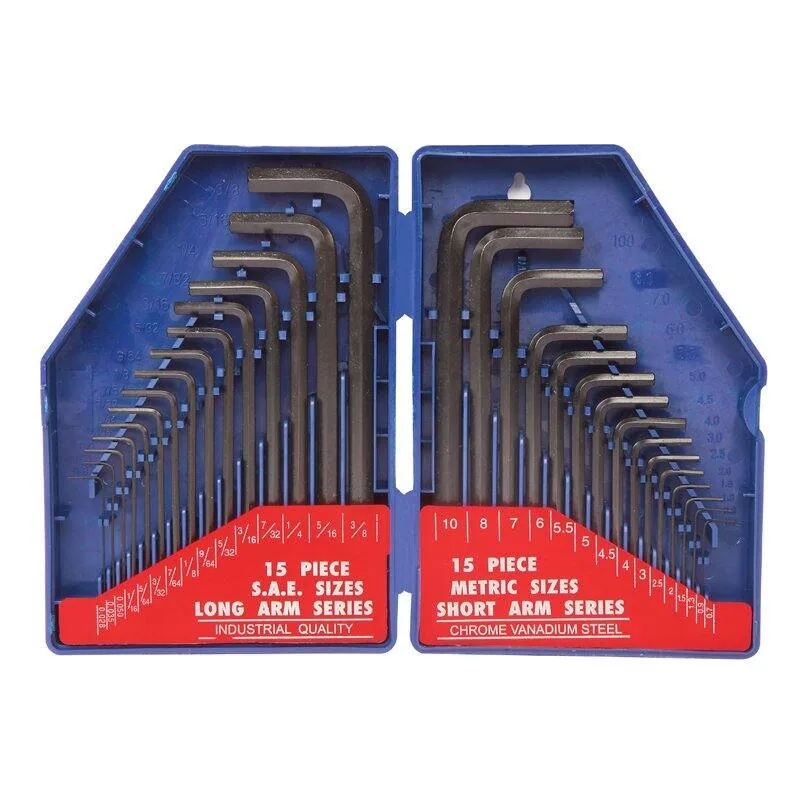
WORKPRO Hex Key 30pcs
$6.99
Troubleshooting: first symptoms and likely causes
Troubleshooting a hex key begins with what changed, not with what broke; the last job tells you more than the manual does. A key missing from a full case at audit was borrowed at the last emergency; trace it before the next emergency finds the gap.
Check the simple things in order on the hex key: grip, edge, joint and fastener, and write down what was tried; a fault log turns guesswork into a service history. None of this is clever, and a hex key that is treated this way repays it in years, not weeks. The hex key keeps no score by itself, but the bench log keeps it for the crews that bother. Habits like these cost minutes and save mornings, which is the best exchange rate a hex key will ever offer.
What the record actually says
Catalogue entry as listed: WORKPRO Hex Key 30pcs (reference WP222018). The listing files under Hand Tools, and attaches the listed price of $6.99 to the offer. The record logs a 30pcs size line. No model designation is carried in the record, so the text names none.
How it compares for the work
Against the alternatives in its class, the hex key turns the buying choice on the work profile rather than on the label on the handle. The wide-range case suits mixed cribs that service several machine families from one drawer.
Compare hex key candidates on the axes the job actually loads: reach, grip, edge life and the price of keeping them sharp. The habit costs nothing to keep and costs less than a single hex key failure to learn on any site.
Buying, stocking and shelf policy
The buying rule for a hex key that survives contact with sites: one in the work, one in the box, and the box labelled. Audit the case on intake and on return; the middle of the loan is where sets quietly shed members.
Purchasing works best when the hex key, its consumables and its spares travel on the same order; three deliveries cost three waits, and one costs one. Keep the hex key routine boring and the tool stays boring too, which is the whole ambition here.
Field failures we keep seeing
The ways a hex key usually dies are few, well known and mostly preventable. Forcing an undersized key into a worn hex rounds both; match exactly or stop and fetch the right one. None of this is clever, and a hex key that is treated this way repays it in years, not weeks. The hex key keeps no score by itself, but the bench log keeps it for the crews that bother. Habits like these cost minutes and save mornings, which is the best exchange rate a hex key will ever offer.
The fix-or-replace decision
Repair or replace is a weekly question for a hex key, and it deserves arithmetic rather than sentiment. The case itself is the service item; a latch that will not hold shut scatters the set one van-bump at a time.
Retire a hex key that fails in ways that endanger rather than inconvenience; a tool that fails safe can wait for parts, and one that fails loud cannot. Boring is the standard for a hex key on this bench; drama always arrives later as an invoice.
What we claim and what we do not
The catalogue record supplies every factual claim on this hex key page, brand and reference and category alike; the rest is trade craft, clearly labelled as such. Two sources meet on this hex key page: the catalogue entry for the facts, and ordinary workshop practice for the advice; neither pretends to be the other. Nothing on this hex key page is invented; the factual half comes from the record, and the craft half is what any journeyman would tell you across the bench. A shelf note and a minute of attention to the hex key now are worth more than a purchase order later.
Where the record for this hex key is silent, the text is silent too; written specification for the listing is available from the desk on request. The habit costs nothing to keep and costs less than a single hex key failure to learn on any site.
| Model | WP222018 |
|---|---|
| Type | Hex Keys |
| Size | 30pcs |
Related products
Reviews
There are no reviews yet.