
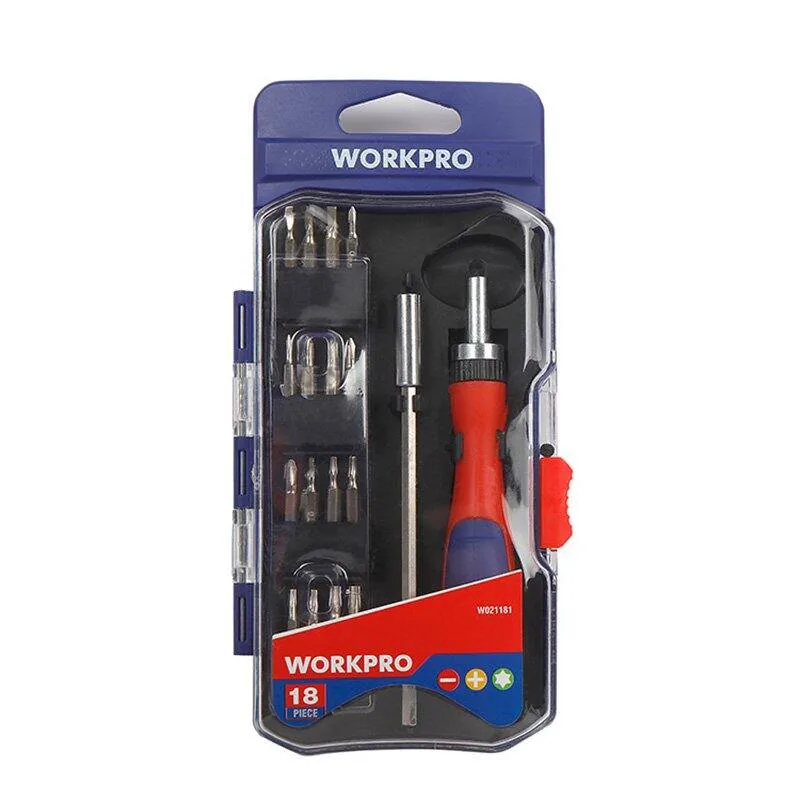
WORKPRO Screwdriver 18pcs
$4.99
Troubleshooting: first symptoms and likely causes
The first report on a failing screwdriver is almost never the fault itself; it is a symptom wearing the wrong name badge. A screwdriver complaint usually arrives dressed as a breakdown but walks like a setting; make it show its papers before anyone reaches for tools. Check that each tip fits the screw head it is meant for before the first job; a tip that rocks in the head will round the screw and then the tip, in that order.
Diagnose from cheapest to dearest on a screwdriver: a clean, a setting and a consumable before any teardown; most returned faults live in the first three checks. Small disciplines, applied on every shift, are what keep the screwdriver off the scrap bench for good.
The catalogue facts
Catalogue entry as listed: WORKPRO Screwdriver 18pcs (reference WP200516). It sits on the Hand Tools shelf of the catalogue, and prices the listing at $4.99. The record logs a 18pcs size line. Model designation is absent from the record, so none is asserted here.
Selection notes for the buyer
Comparing screwdriver options honestly starts with the jobs they will actually see this quarter, not with the ones they could theoretically do. The right screwdriver for a crew shows up in the work diary long before it shows up in a datasheet; read the diary first and shop second. Among the screwdriver choices open to a buyer, the differences that matter repeat daily, and the differences that impress appear once a year at best. It suits a general assembly kit where the driver is chosen per fastener and the tips wear out long before the handle does.
Put two screwdriver candidates side by side and ask what each costs on its worst day, not its best; the worst day is the one that decides the purchase. Judge screwdriver options by their second year, when consumables, spares and operator habits have all priced themselves in; year one lies to everyone. A screwdriver comparison that ignores the store room is incomplete; the option the store can actually support is the option that keeps working in March. The habit costs nothing to keep and costs less than a single screwdriver failure to learn on any site.
Buying, stocking and shelf policy
The buying rule for a screwdriver that survives contact with sites: one in the work, one in the box, and the box labelled. Keep the tips in their holder rather than loose in a pocket; a pocket is where a tip gets lost and where the next screw gets chewed.
A shelf policy that labels, dates and rotates screwdriver stock beats a larger budget; the cheapest tool is the one already on the shelf when the job calls. Keep the screwdriver routine boring and the tool stays boring too, which is the whole ambition here.
How tools of this class usually die
Failure reports for a screwdriver repeat themselves across sites with remarkable discipline. A tip that cambers out of the head is worn, not the wrong size, and continuing to push is what damages both the fastener and the driver. What separates a screwdriver that lasts from one that does not is rarely the specification on the label; it is whether anyone wrote down what happened last time.
Repair, replace or retire
A screwdriver repair decision made at the bench with numbers beats one made at the van with feelings, every week of the year. The honest question about a tired screwdriver is not can it be fixed but should it be, and the parts list answers it faster than optimism does. Every screwdriver reaches the crossroads where the next repair costs more than the tool; the crews that spot the crossing keep their budgets. Tips are consumables and are meant to be replaced early; a handle with a worn bit holder is worth replacing, but a chipped tip is not worth keeping.
Weigh the repair of the screwdriver in hours as well as money; a spare that takes the tool off the van for a week is not a cheap spare. Log every screwdriver repair with its date and its parts; the second entry on the same fault is usually the signature on the replacement order. Set a screwdriver rule in advance, such as no more than one major repair per season; rules made in advance survive the pressure of the moment. Boring is the standard for a screwdriver on this bench; drama always arrives later as an invoice.
What we claim and what we do not
Everything factual on this screwdriver page is drawn from the catalogue entry and the library record; the technique passages are standard trade craft, not specification. Keep the screwdriver routine boring and the tool stays boring too, which is the whole ambition here.
Silence in the record means silence on the page; for a written specification of this screwdriver, ask the desk and it will be sent over. This screwdriver page stretches nothing and fills nothing; what the record does not carry, the desk will provide in writing when asked. Every gap in the screwdriver record stays a gap here; the desk holds the written specification and sends it to anyone who asks for it. The habit costs nothing to keep and costs less than a single screwdriver failure to learn on any site.
| Model | WP200516 |
|---|---|
| Type | Screwdrivers |
| Size | 18pcs |
Related products
Reviews
There are no reviews yet.